

Why Capable People Leave in the Middle of (AI) Transformations
It’s not the work — it’s the wait between finding a problem and being allowed to fix it.

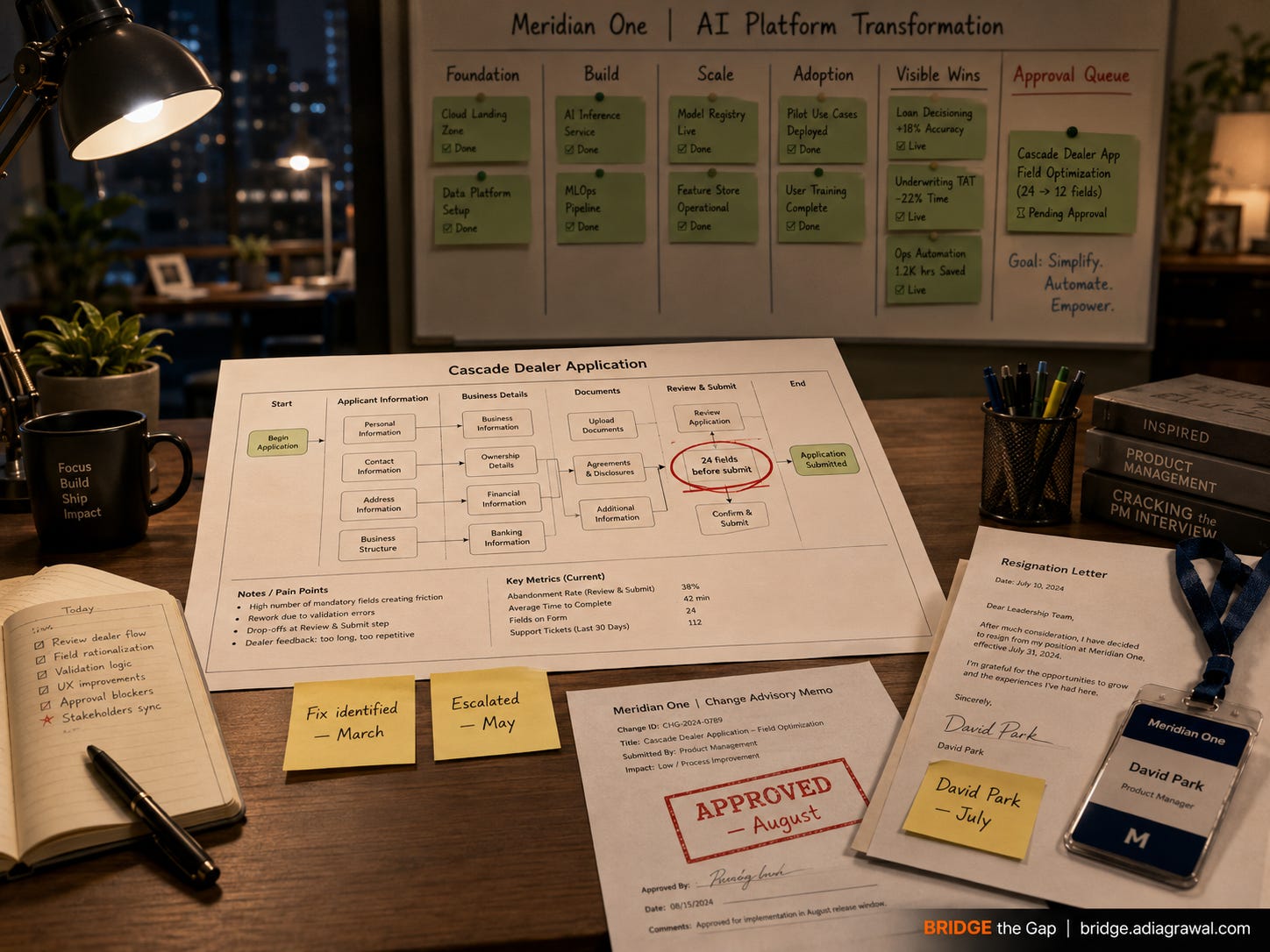
TL;DR — A synthetic story from my executive experience. Names, dates, and details are composed.
In Q2 2025, David Park was the product leader at the center of an AI-enabled platform transformation. He found that mission success needed a foundational fix. A fix that would improve customer experience, speed up originations, and give AI the clean data it needs. He raised it, escalated it, and waited for approval to fix – for months. He resigned in July, before it came through. Transformations rarely die from bad strategy. They die from conditions, and from capable people leaving.
• • •
I learned about David Park from his exit interview. He was already gone by then.
He had spent six years at Meridian, an equipment and dealer-finance company. In late 2024, Meridian made its biggest bet in a decade: an AI-enabled platform transformation it called Meridian One. The mission: make the dealer and customer experience so good that revenue growth is inevitable. David was the product leader at the center of it.
While the program chased visible wins, he kept returning to a problem no one wanted to own. The dealer application, called Cascade, asked for twenty-four fields before a dealer could submit a customer for financing. A result of old products and rules. Fewer than half who started the application finished in one sitting. The ones who quit took their business elsewhere — a few million dollars a quarter, the company never counted as lost, because the abandoned applications just didn’t show up on any report.
The fix was not flashy — part of why no one had done it. Cascade had to be cleaned up and redesigned before AI could do anything useful. The models would only be as good as the data the form collected. Done right, it would improve the customer experience, speed up originations, give AI clean data, and become a template for the flows that came after.
In mid-March 2025, 2025 he brought it forward. In May, he escalated it formally, numbers attached. Then it went to the part of the company that approves such things. He waited. Authorization came in August, and the redesign shipped in September. David resigned in July — a month before the approval he had chased since spring, two months before his own work went live.
In his exit interview, he was asked what Meridian could have done differently. He wrote one line, “I found problems. I could not fix them at the speed they needed to be fixed.”
• • •
I never met David Park. His story reached me through Sofia, an advisor on the program, who could not stop thinking about that exit interview.
She had read it late one night, the floor empty around her. The form was not what made her think; that was already fixed. What stayed with her was the rest of it — how a company could put its best product leader on its most important bet, watch him find the one thing that would make it pay off, then take four months to let him touch it.
She wrote down what she saw: the four months David spent waiting; the other problems he flagged that never left the queue; the way the program treated the work that mattered most as the work that could wait. By the time she stopped, she had six items.
She called me that same week. “We need to understand everything that keeps problems alive while the people who can fix them run out of patience.”
• • •
Transformation programs rarely fail because the strategy is wrong. They fail because of the conditions that slow them down — real, ordinary, practices and behaviors — the building blocks of corporate culture.
Most are built into the company over many years, on purpose. Approval chains, so money does not move without sign-off. Ownership is split across teams, so no one person can break things.
They gave Meridian the stability it needed when it was younger and growing fast, and they worked. Now they had outlived the moment that made them sensible.
An AI transformation does not tolerate these conditions; it strains them. The technology moves faster than the company’s decision-making can, and the gap between what a capable person sees and what the company lets them do becomes a failure mode.
The condition that broke David is the simplest of all: the distance between seeing a problem and being allowed to fix it. Four months does not sound fatal in a planning review. It is a different thing to live inside it — to have the fix in hand, know it is right, and watch the customer experience erode and the program idle while approvals move without urgency. Almost no one measures this distance. Yet the people best able to see what needs fixing feel the wait most, because they keep finding things worth fixing.
Five more conditions sat on Sofia’s list, and David had hit several at once. The full set is in the field guide below. They keep working to derail transformations — in the background. The cost shows up — in a slipped quarter, a stalled program, and, most expensive of all, an exit interview from someone the company could not afford to lose.
• • •
It would be easy to read this as a story about AI, because AI raised the stakes. It is really a story about judgment.
The newest technology a company can adopt still depends on an old human decision: to recognize the foundational work for what it is, put it ahead of other things, and clear the path before capable people give up. No model makes that call. It is the same decision behind every product, every mission, every problem worth solving — how fast a company moves from seeing the answer to being allowed to act on it, and who owns the friction in between.
The cheaper path is the one Sofia was pointing at. Pick one condition now — the one doing the most damage this quarter — and give it a person with a clear path, resources, and air cover.
So it is worth asking, while the answer can still change something: which of these conditions is running up the costs and delays in your transformation right now, and who are the capable people deciding whether to stick around?
• • •
Please do take a moment to share your thoughts, comments, likes, and questions.
Enjoy the companion field guide included below.
Thank you for reading,
Adi
• • •
Field-Guide
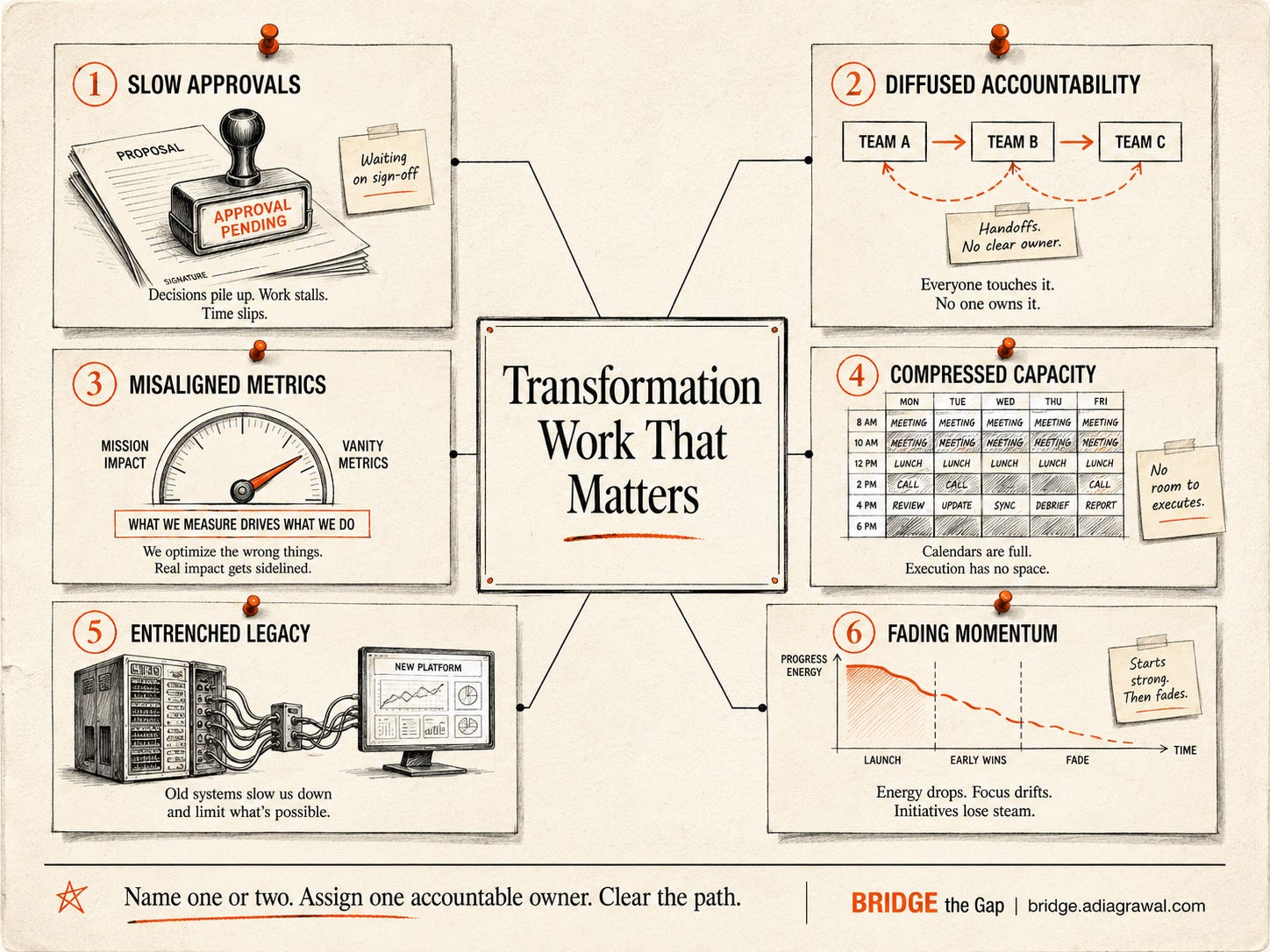
Most companies run several at once; AI and most Transformations strain every one of these.
Slow Approvals — the distance between finding a problem and being allowed to fix it; breaks your best operators’ patience; AI only widens it.
Diffused Accountability — ownership split across teams until no one owns outcomes end-to-end; one person finds it, another approves it, a third builds it, and no one answers for whether it works.
Misaligned Metrics — people are rewarded for behaviors the changes are meant to replace; they optimize for what is scored; they ignore what the mission needs.
Compressed Capacity — the people best able to lead the change are already full; they are running a full existing business; the slack for change is just not there.
Entrenched Legacy — systems, processes, or contracts that cannot change quickly; for AI — every new design, every model trained on their data, inherits the old limits.
Fading Momentum — early wins go unrewarded and early losses unaddressed; attention drifts; energy leaves.
Name one or two doing the most damage this quarter, and give them to accountable owners — named individuals — not committees or forums.