

What We Did Not Build
Success and wealth are always enabled by the Commonwealth created by those before us

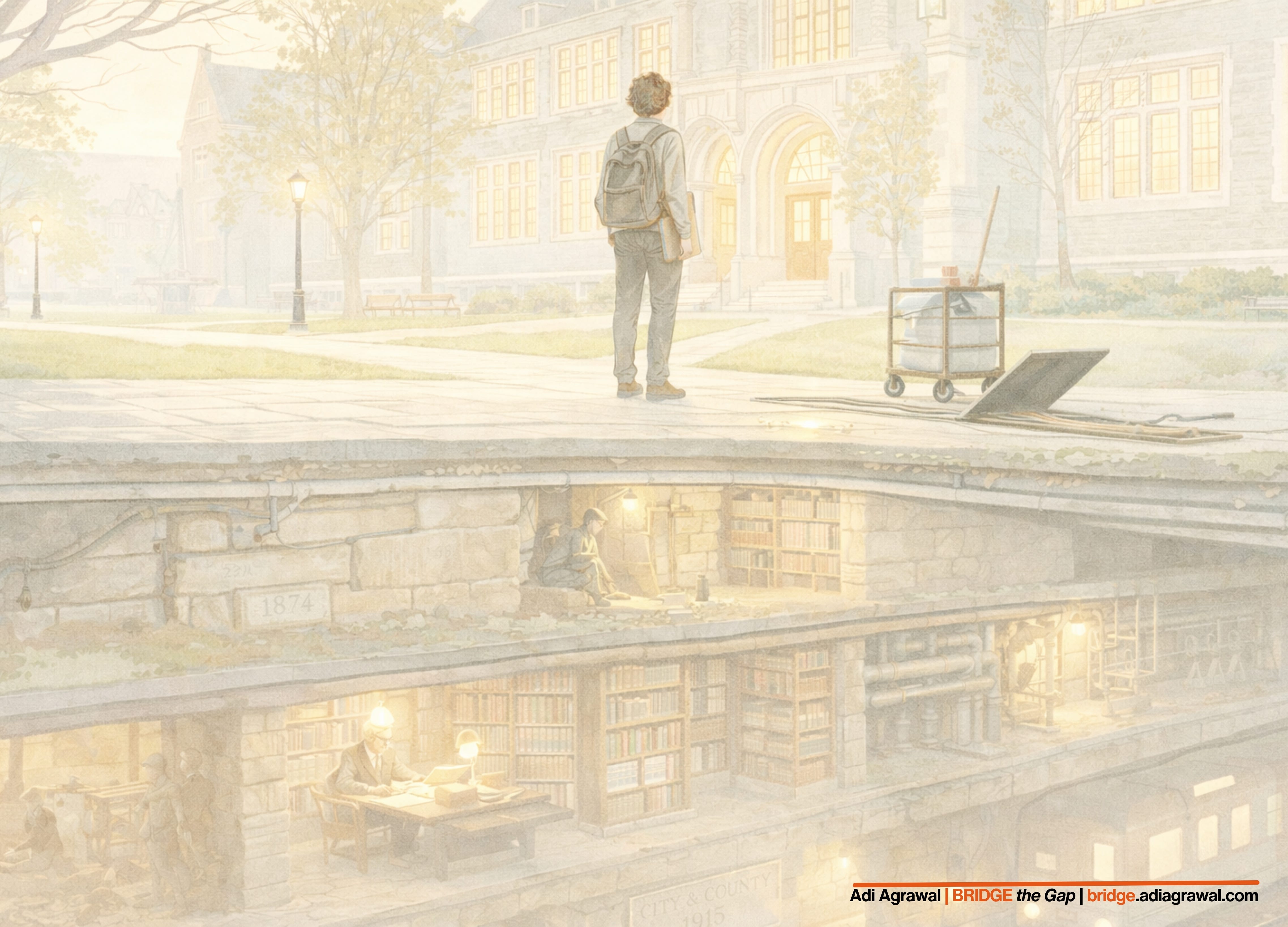
Success is never a solo climb. Our greatest wins rest on the invisible “Commonwealth” of shared sacrifice and civic trust.
Now the story…
By the time the bursar finished explaining the payment options, Claire had stopped pretending to look at the pamphlet in her hand. She folded it once, then again, until it had the dense, compact shape of something she would never read and could not yet throw away. Her son Ethan was sitting beside her, long legs tucked awkwardly under a chair built for eighteen-year-olds and their parents, staring at the framed aerial photograph of the campus on the wall as if it might offer an affordable alternative of the campus he had fallen in love with.
The woman across the desk had the polished tone universities train into people who spend their days discussing devastating numbers in humane language. She slid a printed sheet forward with one finger and said, “Most families think in terms of annual cost, but many find it useful to consider the long-term return.”
Claire gave a wry smile, “That’s one way to think about it.”
I was there because Ethan had asked if I would come. I had known Claire for years, first through work, then through neighborhood dinners, then through the slow, ordinary overlap by which people become part of one another’s lives without any formal decision ever being made. She was originally from Ohio, a public-school teacher who had spent twenty years persuading other people’s children to take themselves seriously. Ethan was the first in her family with a real shot at a place like this, and there was enough pride around him that day to fill all our hearts.
There was also the bill.
The campus was beautiful in the way highly sought-after and expensive institutions often are. The stone looked old in the right places and recently repaired in the others. Nothing announced its wealth. Wealth, at that level, rarely does.
The bursar went on, talking now about grants, loans, work-study, and family responsibility. Claire listened with the stillness of someone making sure annoyance did not spill over into disrespect. Ethan said almost nothing. At eighteen, he had already learned the dangerous habit of tempering his hopes.
When we stepped outside, the air was cold and bright, the kind of spring afternoon that makes every college seem briefly worth any price. Students were crossing the quad with backpacks slung low, laughing in small clusters, holding coffee cups with the casual entitlement of people already within the system. Claire stood on the steps and looked back at the building.
“We can do it,” she said.
It was not a triumph. She meant the arithmetic.
Ethan said, “Mom, I can take loans.”
“You will,” she said. “That was never in doubt.”
Then she looked at me, not for permission but for witness. “It’s just strange. They talk like we’re buying a finished product.”
I said nothing at first. We watched a maintenance cart move slowly along the path, stopping beside a flower bed where two grounds workers were replacing early spring plants that had browned at the edges after a late frost. A tour guide was leading another family toward the library, reciting a line about alumni impact that I had now heard twice that day.
Claire said, “We’ll pay. A lot. But this” – she gestured toward the campus, the library dome, the labs, the green that had been maintained too perfectly to look accidental – “this did not begin with us.”
Later, in the car, Ethan asked whether it was worth it. Claire kept her eyes on the road. “That depends on what you think you’re paying for.”
He waited.
“We’re not paying for buildings,” she said. “Not really. We’re paying to step into something that was built before we arrived.”
There are moments when a parent says something profound. Ethan turned toward the window and did not answer, but he had heard her. I could tell.
A few weeks passed.
Our train was stalled. It was a Thursday morning, every seat taken, every standing passenger carrying some blend of caffeine and work obligations. I was on my way downtown for a board session and had already read through the briefing papers once. Across from me, a young man in a navy suit was editing slides on his laptop with the frantic precision of someone who had left too little time. Beside him, a nurse in scrubs was half asleep against the window. Two teenage boys in school blazers were arguing softly over the game from the night before.
Then the lights flickered, the train gave a low mechanical shudder, and everything stopped.
For a while, no one said much. People looked up, then back at their phones, then up again. The conductor came on with the familiar calm of a man trained to make inconvenience sound temporary and under control. There was a signal issue ahead, he said. We would be moving shortly.
We did not move shortly. After ten minutes, the suit stopped editing. Another twenty minutes – the teenagers had stopped talking.
We could feel the dependency in the air now, though most people would not have used that word. We use infrastructure all day and resent it only when it does not perform. A woman near the door, maybe in her sixties, said to no one in particular, “This city charges enough. You’d think trains would run.”
A man standing beside her, wearing a hard hat clipped to his backpack, said, “They usually do.”
It was not defensive. Just factual.
She said, “That’s not the point.”
He shrugged. “Kind of is.”
No one joined in. That is one of the more interesting things about shared inconvenience. It exposes us as people, but only in flashes.
When the train finally inched forward, there was a collective exhale too intimate for strangers and too brief to be called relief. The city emerged at the bend, and the skyline appeared like a staged set.
At the final stop, Union Station, people poured out and resumed their lives at once, stepping onto platforms, into elevators, toward meetings, classrooms, hospitals, courtrooms, and kitchens. The whole city ran on systems most of them had not built, could not repair, and barely noticed until interruption forced a kind of humility upon them.
That afternoon, I mentioned the morning delay to my colleague Tom, a former consultant from Boston who now served on two more committees than any human should and treated civic frustration as a sport.
“Transit’s broken everywhere,” he said. “Public sector. No accountability.”
Tom had worked hard for everything he had. He reminded you of this not quite often. He admired competence, especially his own, and had developed that late-career habit of speaking about institutions as if they were old employees who had disappointed him personally.
“You still took the train,” I said.
He smiled. “What’s the alternative? Helicopter?”
“We complain about systems only when they fail,” I said. “When they work, we don’t notice or feel gratitude.”
Tom gave the small, practiced laugh of a man indulging philosophy before returning to the spreadsheet. “Meer, I knew there was a sermon hiding in there.”
There wasn’t, or not the kind he meant. The older I get, the less interested I am in speeches. Most people don’t change by being told what to think.
They change. Just like I did – in an unremarkable moment.
That moment when they realize how much of what they call personal success was scaffolded by other people’s discipline, taxes, labor, restraint, patience, and invisible maintenance.
Mine came many summers ago at a dinner party in Connecticut, of all places. We were around a long table set by our hosts, Laura and David Whitmore, who made old money look accidental.
The guests were the usual mix that midlife assembles if you stay in one orbit long enough: a surgeon, a startup founder, a lawyer, a public-school teacher, someone in venture capital, someone in local government, one person between careers, two pretending not to be worried about their children, and everybody came with some version of unfinished private news.
The argument began over dessert, which is where most respectable arguments arrive. David’s daughter, Anna, had just announced she was leaving a stable consulting job to start a design studio with two friends. She said it plainly, without drama.
David set down his fork. “I’m supportive,” he said, in the tone men use just before proving they are not. “I just want to make sure this isn’t one of those romantic reinventions people make after reading too many essays on the internet.”
Anna laughed. “That’s not what this is.”
“You’ve got health insurance. A retirement plan. A path.”
“A path to what?”
There it was. The actual question.
Laura intervened with the speed of a woman who had seen this movie before. “She’s not dropping out to join a circus.”
David ignored her. “People act as if they have invented themselves. They don’t. Stability matters.”
At the other end of the table, Elena, who had spent twenty-five years teaching and had the unnerving gift of saying true things in a tone that made disagreement sound childish, said, “So does inheritance.”
The table went quiet.
David looked at her. “Meaning?”
“Meaning,” she said, “your daughter is able to take a risk partly because so much was made stable before she ever got there. Family. Schools. Roads. Contract law. The internet. The clients who trust a designer because other people have built industries where design has value. Even the idea that she can try and fail and still be respected – that came from somewhere.”
Anna looked down, not embarrassed, just thoughtful now.
David said, “No one’s denying society exists.”
Elena smiled. “That’s a very generous concession.”
A few people laughed. He did too, reluctantly.
Then Anna said, more softly than anyone else had spoken all night, “I know I didn’t build everything. That’s kind of the point. I’m trying to build something with what I was given.”
On the drive home, my wife asked why I had been so quiet through most of the dinner.
“I wasn’t quiet,” I said.
“You were Meer quiet.”
That was fair.
Outside the window, service roads curved off the highway toward neighborhoods, warehouses, schools, power lines, gas stations, distribution centers, the lit and unlit machinery of ordinary life.
It struck me in that moment that ambition often forgets context. Young people sometimes imagine they alone are making their future. Older people sometimes imagine they alone paid for their present.
What I had noticed all around me was a thinning of memory. People are becoming more fluent in ownership and pride than in inheritance and gratitude. We were losing the awe for what came before us, and that which we use every moment of our lives without thinking.
And once that happens, respect becomes optional. Shared effort starts to feel like theft. Even love, under enough pressure, becomes a list of transactions.
A few days later, Ethan called to say he had decided to accept the offer.
“How does your mom feel?” I asked.
He laughed. “Like she’s buying a country.”
“She might be.”
There was a pause. Then he said, “I think I understand what she meant that day.”
I asked what part.
“That I’m not just paying to go there,” he said. “I’m stepping into something generations before me put together, and people I will never know kept alive.”
After we hung up, I stood at the window for a while without moving. Outside, someone I would never know was repairing a water main two streets over. I could hear the machinery through the open window, steady and unheroic, the sound of one more thing being maintained before most of us had the chance to miss it.
Enjoy your loved ones and the rest of your day. And thank you for spending some of your day with me.
Warm regards,
Adi
♻️ If you liked this - Restack this!
➕ Follow Adi Agrawal on LinkedIn