


At 7:42 a.m., Maya clicked our digital ad between two check-ins. A Slack thread titled Manager support sat pinned at the top of her screen. She hadn’t opened it yet, but she already knew what it would contain: another manager asking for help with a conversation they didn’t want to mishandle.
She typed: reduce manager burnout microlearning wellness program.
She landed on our page.
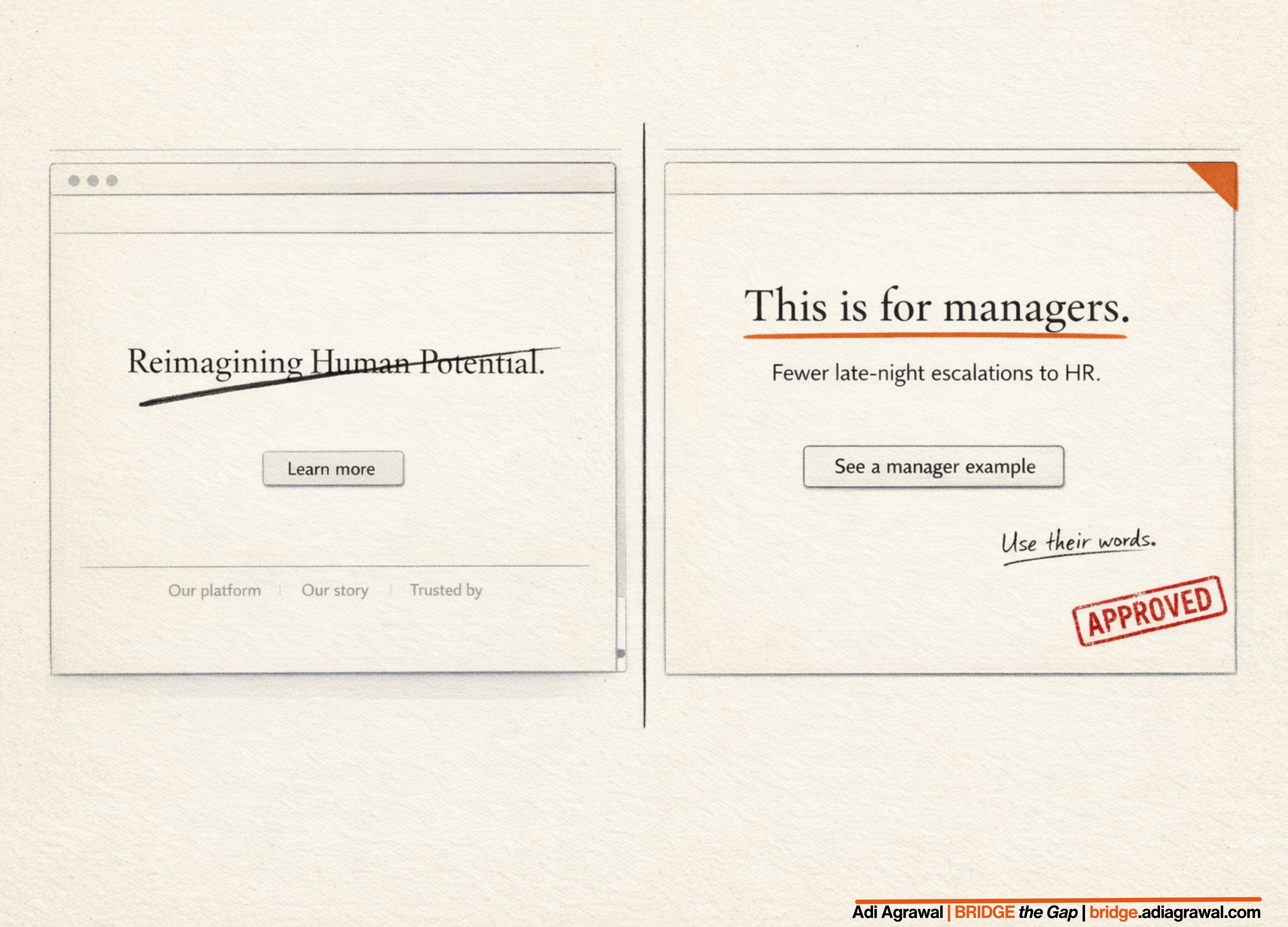
Wide margins. Soft photos. Awards. Partner logos. A large headline:
Reimagining Human Potential.
A button beneath it: Learn more.
Maya scanned for the words she used at work – manager, burnout, after-hours, hard conversation. She scrolled. The page offered “Our platform,” “Our story,” “Trusted by,” and feature tiles with names that didn’t match what she was trying to fix. There was no sentence that told her who this was for. There was no sentence that told her what would be different next week.
She closed the tab.
Then she forwarded the link to her HRBP lead: “Do you know what this actually does for managers?”
Her HRBP replied, “Not sure. Want me to ask them?” – and Maya answered: “Yes. If it’s real, we need it.”
That exchange reached us because our growth team routes unclear customer messages to a shared inbox that I monitor. I’m the Chief Strategy Officer.
At 8:11 a.m., the thread hit the alias. At 8:20, someone posted a screenshot in our launch channel. By 9:00, it was on the projector beside our homepage. I walked in and saw Maya’s sentence sitting next to our headline, and the gap was obvious.
I read her line out loud.
Then I looked at the screen and asked, “Where does she get her answer?”
A designer’s hand went to the mouse. The page scrolled a little, then a little more. The room stayed focused on the screen.
The chat widget pinged. “Are you for HR teams or individuals? I can’t tell.”
Another ping: “What does this replace?”
Someone started typing a reply and stopped. The question was fair. The page wasn’t helpful.
That afternoon, Maya joined the call. Camera off. She asked the same question she’d emailed. “Does this reduce burnout for managers,” she said, “or is it general learning content?”
We answered with the sentence we always reached for when we wanted to sound solid: patent pending method, tailored programs, universal impact, any company. It was smooth, and it did not land.
Maya didn’t argue with it. She skipped past it. “Tell me what my managers do in week one,” she said. “What changes on Monday?”
After the call, her email arrived.
Subject: Follow-up — unclear fit
“Not sure this is built for manager burnout vs general L&D. If you have a concrete example for a 600-person tech org, send it.”
The CRM note was shorter: No next step. Unclear fit.
The next morning, she forwarded a screenshot from their ticketing system.
Manager support tickets, last 7 days: 18.
Under it were subject lines: difficult conversations, workload overload, team conflict, performance plan anxiety, new manager needs help.
At 9:05 a.m., I called Maya and asked if she could spare ten minutes to look at the page with us. She generously agreed.
I put her on speaker in the room.
We asked what she needed to see right away, before a demo or a deck. Maya spoke in the practical, clipped way people do when they’ve explained the same problem too many times. She didn’t want to translate our language into hers. She wanted the page to say, plainly, that it was for managers – and for the People Ops teams buying support for them. And she wanted the second sentence to be something she could repeat internally, because she would be asked, almost immediately, what changes first in their world if they pay for this.
When she described “first,” she didn’t talk about culture or transformation. She talked about evenings. She talked about the late-night pings that pull HR into a manager’s panic after hours because there wasn’t enough support earlier in the week.
We read the first screen to her. Maya listened until the end and said, “That could be anything.”
We scrolled and read the next section. She waited again, then said, “Still nothing that tells me it’s for my managers or me.”
On a laptop at the end of the table, the chat message from yesterday was still open: HR teams or individuals? Maya heard it and said, “That’s the same problem. I shouldn’t have to guess.”
We went back to the first line and replaced it while she listened. No debate; we narrowed into one job: write a sentence Maya would forward with clarity.
The first line named the buyer and the person the buyer was trying to protect: People Ops and Managers.
For the next line, Maya kept returning to the same phrase. “Late-night escalations,” she said. “After-hours.”
So that line used her words: Fewer late-night escalations to HR.
When we got to the button, Maya didn’t want another invitation to browse. She wanted proof she could picture. The button became: See a manager example.
At 11:10 a.m., I replied to Maya in the same thread. I pasted a screenshot of the updated first screen and wrote one sentence: “Is this closer to what you meant?”
At 11:47 a.m., she wrote back.
“Now I understand what it is,” she said. “Can you show this to me with a realistic situation?”
She pasted details: two new managers, a reorg, time zones, one employee on a performance plan.
A calendar invite followed from her assistant.
Title: Manager support session — your scenario
Tuesday, 2:00 p.m.
In the notes, Maya wrote: “Stay on what managers will do in the first week.”
On Tuesday, we started where she pointed: a manager at 9:12 p.m., staring at a message, deciding whether to respond now, delay, or avoid it. We stayed with the next day’s calendar and the conversation that keeps getting postponed. We showed what a ten-minute lesson looks like when the day is already full, and what the first check-in looks like when a manager doesn’t want another meeting but still needs a place to practice the words.
Afterward, Maya didn’t send a recap. She made a decision.
At 4:38 p.m., her email came in: “Pilot with product org. I want fewer late-night escalations.”
Our head of growth replied with dates. Maya’s assistant returned three options.
Later, in the launch channel, someone posted Maya’s original question next to the updated first screen. A few reactions appeared, then the channel moved on.
Folks, this is a story example I have lived through countless times. Too often we are marketing without clarity of the customer and the offer. We make it about ourselves.
I hope you enjoy this new format I am trying.
Enjoy your loved ones and the rest of your day!
And thank you for spending some of it with me.
Warm regards,
Adi