

The Twenty-Minute Promise
What We Don’t Know and the Partners Who Help Us

• • •
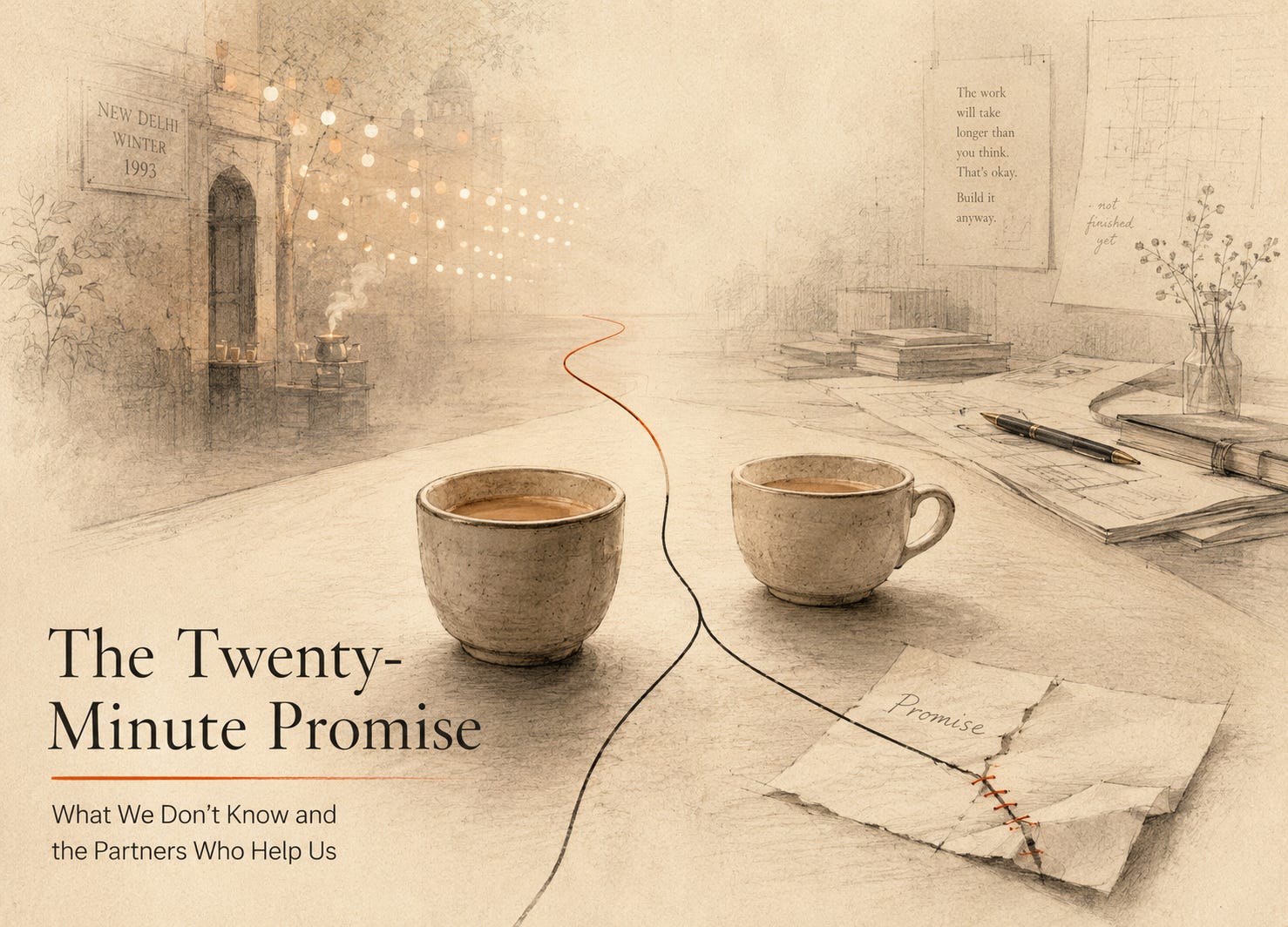
The room was loud in a way that usually makes me want to leave. It was 1993, a winter gathering in New Delhi in an unfamiliar space that smelled of the festival season and tea. I was twenty-six, possessed by that specific arrogance of a young man who thought competence was the only meaningful pursuit in life.
Then I met her – saw her smiling eyes.
We talked for maybe twenty minutes in the entire evening. We didn’t discuss any plans or metrics. We talked about the things that actually matter – the way we saw the world, the things we refused to tolerate, and some of the quiet ambitions we hadn’t quite put a name to. By the time the twenty-first minute arrived, I knew. It wasn’t a romantic epiphany; it felt like a realization.
Thirty-two years later, that decision remains the anchor of my life.
We often treat a partnership as a series of evaluations. We check credentials, we run due diligence, we look for alignment. But often, true partnership – the kind that functions as a superpower – is rarely found in models and spreadsheets. It is found in the gaps between what we can do and what the world requires of us. It is the realization that the sheer girth of what we don’t know is too much to consider.
• • •
The Week-Long Investment
In November 2017, I made a different kind of decision.
I had met a potential professional partner through a mutual contact I trusted. He had the resume: a twenty-year successful sales and development career, a top role at a mid-cap service firm, and a way of speaking that assured me he was the real thing. We decided to build a business and platform together. I spent three months on the business strategy and architecture. I committed my personal capital, quit my C Suite role, and brought along a lieutenant who trusted me implicitly and left their thriving role to help us build.
On a Monday morning, we signed the operating agreement. We shook hands. We talked about the “100 million milestone” we were going to run to in 3 years.
The following week, on a Thursday afternoon, he called me.
“Adi,” he said. The line had that hollow quality of a long-distance call, even though he was two miles away. “I’ve been thinking. I don’t think I want to build this with you.”
I sat in my chair and watched a bird land on the windowsill. The documents were still on my desk, the ink barely dry. He didn’t offer a reconsideration or a real dialogue at the time. He didn’t offer a strategic pivot. He simply walked away from the promise because the reality of the work – the “contact sport” of actually building something – was less appealing, with me being a co-founder.
I learned more in that week than I did in two years of graduate school.
The failure wasn’t his. It was mine. I had fallen in love with the “idea” of his past successes instead of looking for the evidence of his character, discernment, and grit. I had ignored the nits – the pauses and delays in his responses, the way he spoke down to people sometimes, the subtle “follow me because I said so” register he used with associates. I thought those were just personality quirks. They weren’t. They were signals of a lack of an all-around service orientation.
• • •
The Art of Overlooking Nits
Most partnerships fail not because of a lack of talent, but because of a lack of grace.
In my advisory work, I often see leaders who are “nit-pickers.” They find a brilliant technical co-founder or a masterful operations lead, and then they spend their energy complaining about the way that person formats an email or the fact that they arrive three minutes late to a stand-up.
They confuse obedience with partnership.
A true partner is not a mirror of your own strengths. If they were, one of you would be redundant. A partner is a different set of eyes. When I work with a Board or a CEO, I look for the people in their midst who are “inconvenient.” The one who asks why when everyone else is nodding.
The superpower of partnership is the ability to accept a person’s strengths and service while intentionally overlooking the nits that don’t impact the outcome.
I have professional partners now in new ventures. They are brilliant at the things I find exhausting. They can sit with a detailed filing for six hours and find the one thing that customers may care about. They also forget to update the shared calendar and have a tendency to use jargon that I’ve spent twenty years trying to excise from my own vocabulary.
I don’t try to “fix” their calendar habits – I update the calendar for them.
Service in partnership is not about doing 50% of the work. It is about doing 100% of whatever is needed to ensure the mission survives every contact with reality. It is being more grateful than expectant.
• • •
The Platform of Oneness
Whether it is a 32-year marriage, a $500M business unit, or a small advisory alliance, the mechanics of success are the same. You are building a platform of “oneness” in an insular and local world.
A partner allows you to see the “otherness” of a situation. They provide the epistemic humility you lack on your own. When I was the only brown line leader in 1990s boardrooms, I relied on my advocates – “my partners” – to bridge the gap between my competence and the biases in the room. They didn’t do it as a favor. They did it because they knew our shared success depended on the “all” of our perspectives.
The best partners I have known all share three traits:
They lead with customer-obsession. Every disagreement is resolved by asking: How does this impact the person who pays us?
They assume positive intent. Even when the “noise” of a build or a transformation gets loud, they trust character over a momentary lapse.
They treat the brand as a promise. They know that if one of us fails to deliver, the promise is broken for both – for all.
• • •
The Closing Beat
I still think about that very fortunate twenty-minute conversation in 1993.
It wasn’t a perfect setting. I probably said something arrogant. She probably wondered why I was talking so fast. But we recognized something in each other that pulled us together – something sturdy.
Anything worth building benefits from a strong partner.
Not because it’s sacred, but because it’s terrifying to build alone. Because the maze is real, and the gravel is sharp, and you will eventually need someone to slip you a cup of chai or coffee and say, “Don’t give up.”
I looked at my phone this morning. A message from my wife about a mundane household detail. A message from my business partner about a delayed vendor deliverable.
I answered both. I didn’t moralize the delays or complain about the mundane. I simply did the next thing required to keep the build moving.
Partnership is not a destination. It is the way you place your feet – one at a time – when the mountain gets steep. Because you know – your partners have your back and will be there to help you out when you get a bit lost.
• • •
Enjoy your loved ones and the rest of your day.
Warm regards,
Adi