

The Golden Rule of Bad Management
Bad leaders hire weak leaders, protect them, and punish the competent.

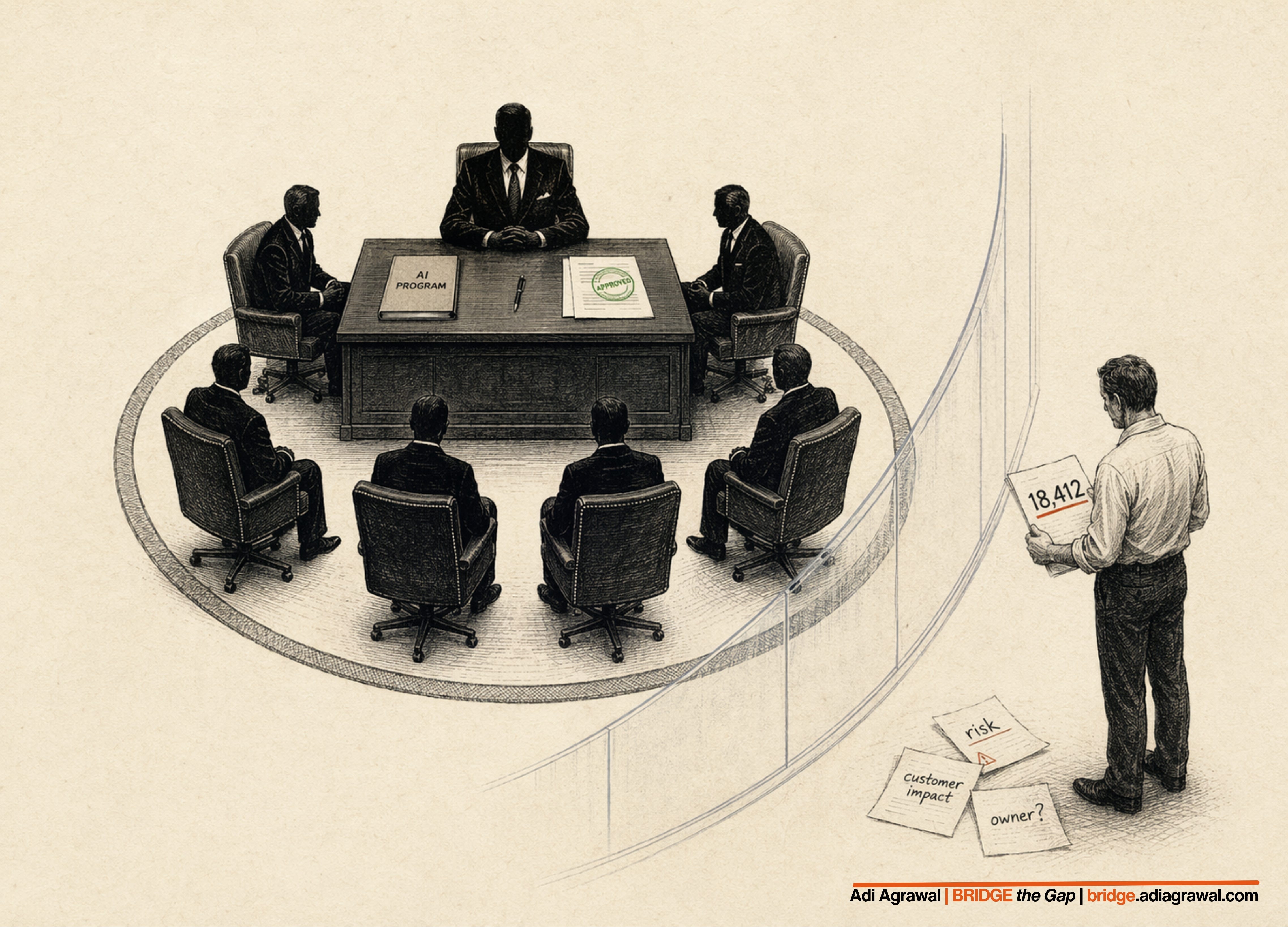
Global Nexus had approved an 18-month, capital-heavy AI program meant to rebuild its consumer business. Inside the company, the program was already drifting.
The reports looked fine. The money was being spent. The CEO sounded confident. But customers were waiting, engineers were warning, and institutional investors were quietly telling the Board that management had lost control.
Then the Head of the Board Strategy and Execution Committee found Meer Singhal, a little-known builder and operator who had spent his career fixing hard businesses without becoming famous for it.
And now the story…
The Number
At 7:42 on a wet Monday morning in London, Priya Menon was still looking at the same number: 18,412.
She refreshed the file once, then again. The number did not change. The reconciliation break in Global Nexus’s European consumer payments platform had grown overnight, which meant another day of manual fixes, another day of client exceptions, another day of waiting for senior people to admit what the engineers already knew.
The issue had started six weeks earlier, when the break count was just under four thousand. Priya had flagged it in a message, then in a meeting, then in a shorter message that took longer to write because she was trying not to sound angry. The answer came back from a director two levels above her: they should avoid creating unnecessary alarm before the AI rollout.
She still had that message.
She kept it because she wanted to remember the moment when the company stopped fixing the problem and started arguing with the people who saw it.
Global Nexus was eighteen months into a large AI-enabled consumer business transformation program, the kind that boards approve to stay current and signal innovation and growth. The program was meant to modernize fraud detection, customer onboarding, credit decisioning, service routing, dispute management, and personalized financial offers across regions. It had a large capital budget, a proud name, and enough outside advisers to make every decision feel solid.
The money was real. The outcomes – they were less clear.
The CEO, Colin Voss, had sold the program as the next chapter of Global Nexus. He spoke about responsible AI, better consumer journeys, faster approvals, lower fraud losses, and deeper wallet share. The board loved the ambition. Investors liked the promise. Analysts liked the TAM slide – after all, a good TAM slide can make everyone believe in magic.
Inside the company, the people building the program were less enchanted.
The source data was messy – for two decades, no one had been able to get it fixed. The fraud models were not ready for three regions. The onboarding workflow still depended on manual reviews in several markets. The payments platform had settlement breaks that should have been fixed before any AI-enabled expansion went near it. Customer service teams were being told to trust routing logic that still could not distinguish between a high-risk complaint and a password-reset request.
But the executive reports stayed clean.
That was the talent of the management team around Voss. They could make delay sound like sequencing. They made risk sound like learning. A broken dependency was a cross-functional opportunity. Six of the eight executives on his team owed their rise to him, and over time, they had become very good at protecting the man who had protected them.
The head of consumer product spoke in an intoxicating Aussie accent about AI-native financial experiences, but could not explain why three releases had slipped after being marked ready. The head of operations, Daniel Reiss, carried himself like someone doing the company a favor by attending his own meetings. The head of risk knew the vocabulary of governance but not the actual exposure sitting in the daily exception reports. The chief people officer talked constantly about culture while the best engineers were taking calls from recruiters and leaving without drama.
Priya had joined Global Nexus seven years earlier, when the company still felt serious. It processed payments and settlement flows for banks, lenders, merchants, and consumer platforms across regions. The work was not glamorous, but it mattered. If Global Nexus failed, customers did not get paid, merchants did not settle, lenders did not book, and consumers sat on hold.
Now the company was spending hundreds of millions to make the business look smarter while the basics were getting harder to trust.
At nine, Priya walked into the incident review with a printed report in her hand, though everyone already had the file. She liked bringing paper to meetings.
Daniel Reiss arrived seven minutes late, holding a coffee and wearing the smile of a man who had never been punished for wasting other people’s time.
Around the room were engineers, product leads, risk analysts, operations managers, and two members of the AI launch team trying not to look directly involved. There was also a man Priya did not recognize at first, sitting near the end of the table with a notebook open in front of him.
Meer Singhal.
The announcement had gone out the previous week. Meer had been appointed Interim Head of Global Consumer Businesses, reporting directly to the Board, with authority over the consumer AI program, payments stability, customer recovery, and regional delivery. The title was strange enough to make people read the email twice.
Colin Voss remained CEO.
The interesting part was that Meer’s appointment had not come from Voss.
It had come from the Board Strategy and Execution Committee, led by Arvind Rao.
Arvind Rao
Arvind was not the sort of director executives dared to dismiss as just another board member.
He had built two fintech platforms before most banks understood that technology providers could become the railroads of modern finance. He had scaled a consumer credit business across Asia, sold a payments company to a global bank, run a public financial infrastructure firm through a regulatory crisis, and still had the unusual habit of reading operational reports before meetings.
People described him as quiet. Rao had been watching Global Nexus with growing discomfort for a year. He did not trust how clean the AI program looked in the board materials. Large capital programs are never that clean unless they are either exceptionally well-run or carefully narrated. He had seen both. This did not feel like the first.
The real pressure came after three large institutional investors began reaching out privately. They started asking whether the Board had enough visibility into the AI spend, whether management had the right operators in place, and whether the consumer business was missing delivery milestones because of technology debt or leadership.
That last one started concerning Rao. Leadership.
Rao took the concerns to the Technology Committee and the Risk Committee. The Tech Committee had been uneasy about platform readiness. The Risk Committee had been uneasy about model governance, settlement exposure, and customer harm if automation scaled before controls were ready. Separately, their concerns sounded manageable. Together, they sounded like a company spending a great deal of money faster than it made good decisions.
Rao pushed for an outside operator to enter the consumer business with direct authority. Voss resisted, as Rao expected him to. Weak leaders often call intervention “confusion” because they prefer everyone confused except themselves.
The search took longer than Rao wanted. The obvious candidates were too polished, too available, too practiced in saying the right things to boards. They had decks, war stories, and that faint scent of performance that wasn’t authentic. Rao did not want a celebrity fixer. He wanted someone who could sit with engineers, investors, and regulators - with ease and honesty.
Meer surfaced late in the process through another board risk chair, who told Rao, “You won’t know him. That’s part of why he works.”
Meer had been a C-suite operator, adviser, builder, and problem-solver across financial services, fintech, risk, technology, and transformation. He had led businesses, repaired delivery failures, advised boards, and walked into broken situations without turning himself into a brand. He had enough range to understand the architecture, enough commercial sense to understand the capital, enough risk judgment to understand the downside, and enough scars to distrust easy answers.
Rao interviewed him four times.
The first time was formal. The second was technical. The third was mostly silence, with Rao handing him anonymized fragments of Global Nexus reporting and watching what Meer noticed. The fourth was over breakfast, where Rao asked him why someone with his background was not better known.
Meer smiled and said, “I spent most of my career doing the work.”
Rao liked that. He also did not fully trust it, which made him like it more. By the end of the process, Rao had decided. The Technology and Risk Committees supported him. The full Board approved the appointment, though not without discomfort. It was one thing to know management was weak. It was another to put a stranger inside the machine and give him tools and authority.
Before Meer started, Rao gave him one piece of advice. “Don’t fight the theater,” he said. “Find the truth. The theater will come looking for you.”
Meer remembered that line when he entered the incident review and watched Daniel Reiss explain control without producing a number.
The Meeting
Reiss opened by saying the team had a workaround in place, the issue was being tracked, and the AI rollout remained within the revised launch path.
Meer asked for the previous day’s break count.
Reiss turned to his deputy. The deputy looked at the product lead. The product lead looked at Priya.
“18,412,” Priya said.
Meer wrote it down and asked what the count had been when the platform was marked stable. No one answered at first. Priya could feel a familiar pause, the one where the room waited to see who would accept the risk of being precise.
“Just under four thousand,” she said.
Meer asked why four thousand had been considered stable.
Priya looked at Reiss, then back at Meer. “Because the report had already gone green.”
The room went still.
Priya had not meant to say it quite that plainly. Once it was out, she felt both exposed and relieved.
Meer asked her to explain the sequence.
The partner bank had changed the file format. The internal mapping logic had not been updated properly. Exceptions were split across three categories, which made the trend look smaller in summary reporting. The team that should have fixed it had been reassigned to support the AI-enabled dispute-routing release, because Voss wanted to show progress at the next investor update. The reconciliation break was now interfering with onboarding for a major enterprise client, and if the AI program scaled on top of unstable payments data, the company would be automating confusion.
When Priya finished, Meer turned to Reiss and asked who had decided to defer the fix. Reiss said the decision had come out of the prioritization forum. Meer paused, then said a forum could not make a decision; a person had to make the decision. Reiss tried again, saying there had been broad agreement. Meer told him broad agreement did not tell him who was accountable.
Priya had seen executives ask sharp questions before. Some did it to perform. Some did it to make other people feel small. Meer seemed to be doing something else. He was looking for the exact place where the company had chosen to ignore facts.
By late afternoon, the story had moved through Global Nexus. Meer had asked for the number. Meer had asked who made the decision. Meer had not accepted “the forum” as an answer.
For people close to the work, this was not dramatic. It was better than dramatic. It was a revolution – and hopefully a shift towards how things ought to be.
The People Above the Reports
In the days that followed, Meer did not spend much time with Voss’s executive team.
That offended them.
They were used to power moving through them. They controlled calendars, summaries, interpretations, and escalations. They knew how to prepare for visiting executives. They knew which phrases worked, which concerns to acknowledge, and which people should not be invited to certain meetings.
Meer was harder to prepare for because almost no one knew him.
He had no famous book, no standard keynote, no repeated slogan, no public doctrine they could memorize and feed back to him. He had been around long enough to have seen most corporate maneuvers, but not visibly enough for them to profile his preferences. Reiss asked a former colleague if he knew Meer. The answer came back: “I know of him. People call him when something ugly needs to get fixed.”
That did not help Reiss.
Meer went to Warsaw and sat with the security architect who had been warning about access weaknesses in the AI servicing platform. The architect, Tomasz Lewek, had a dry manner and the tired eyes of someone who had already explained the same risk many times. He showed Meer how access rules had been relaxed to accelerate testing and how exceptions had become the norm. A launch planned for the following month would expose sensitive consumer case data to teams that did not need it.
“Who knows?” Meer asked.
Tomasz named three people.
“Who can stop it?”
Tomasz gave a small laugh before he could stop himself. “In theory or in the company?”
Meer did not smile. “In the company.”
No one had stopped it because stopping it would mean not launching.
In Singapore, Meer met Lian Chen, an operations director whose team had grown from three people to thirty-one to support manual reviews that the AI program was supposed to reduce. Every week, her team corrected customer records, fraud flags, and escalation queues created by systems that were described in board materials as progressing toward automation. Lian did not complain. That made her account even more damning.
In New Jersey, he met Marcus Bell, a client implementation lead who had kept his own list of customers who no longer trusted Global Nexus delivery dates. He had started the list for himself, then for his team, then because no official report seemed to match what clients were telling him.
Meer asked him why he had not escalated it.
Marcus looked at him for a long moment and said, “I did.”
Meer did not ask people to believe in him. He asked them what decisions they would make if they knew he would protect them from pushback and fallout.
Priya asked for ten days, three engineers, and a delay to the AI dispute-routing release until the reconciliation logic was fixed. Tomasz asked to stop the servicing launch until access controls were rebuilt – from scratch. Lian asked to freeze expansion in two markets until manual review volumes were understood. Marcus asked to call two major customers and reset delivery commitments before another missed date made the company look either careless or dishonest.
Meer approved all four.
And – he stayed close enough that the approvals could not be reversed in side conversations.
The Weak Circle
Voss had built his management team for his success and comfort.
He would never have described it that way. He would have said trust, chemistry, shared vision, and cultural fit. But those words were a cover for something else. He liked people who made him feel decisive. He promoted people who supported his narratives even when the facts were different.
Six of the eight top executives had risen that way.
They protected one another because everyone’s survival depended on the others’ silence. Reiss needed the product chief to keep pretending that releases were late because the business was ambitious, not because the underlying platform was unstable. The product chief needed risk to keep describing control gaps as manageable. Risk needed the people leader to keep morale concerns away from the Board. The people leader needed everyone to keep pretending attrition was part of a competitive talent market.
It was not a conspiracy in the cinematic sense. There were no secret meetings in dark rooms. It was ordinary, daily self-protection. A thousand small choices not to say the truth.
Meer’s first formal review with Voss and the executive team was held on a Thursday afternoon. Voss opened warmly, praising the importance of speed, discipline, and responsible innovation. He welcomed Meer’s partnership. He said the company needed to move as one team.
Meer let him finish.
Then he asked Reiss for the owner of the reconciliation deferral, the expected customer impact if the AI dispute-routing release proceeded on unstable data, and the reason the exception categories had been split in the executive report.
Reiss had brought a deck. Meer asked him to close it.
The meeting became uncomfortable quickly.
The chief product officer tried to explain that the business was balancing modernization with customer commitments. Meer asked which commitment required using inaccurate operational data. The head of risk said the issues were being monitored. Meer asked what threshold would trigger a stop. The people leader said teams were under stress because the transformation was difficult. Meer asked how many senior engineers had left in the past two quarters and which programs they had worked on.
Elena Park, the CFO, said little. Simon Vale, the general counsel, said even less. But both watched carefully.
After the meeting, Voss called Rao.
He said Meer was moving too fast, creating confusion, bypassing established leadership, and undermining confidence in the AI program.
Rao listened.
When Voss finished, Rao asked him whether the reconciliation break count was now below ten thousand.
Voss did not know.
The Work Takes Over
The first month was ugly.
The reconciliation fix delayed the AI dispute-routing release. The access-control rebuild delayed the servicing launch. Two customer calls were painful. One client procurement head said, “This is the first time in six months someone from Global Nexus has told us something I believe.” Marcus sent that note to Meer.
Meer sent it to Rao with no comment.
Rao replied, “Keep going.”
The Board reports changed next. Meer did not redesign them. He made it harder to hide the truth. Each major AI program workstream had to show capital spent, decision owner, customer impact, control gaps, data readiness, operational dependency, and next irreversible decision. Every red item needed a name. Every green item needed evidence. Every delayed item needed the original date, not only the revised one.
The first version was a mess.
That was the point.
The Technology Committee finally saw that several AI releases depended on data flows and quality that no one fully owned. The Risk Committee saw that model approval was being treated as a document process while operational controls lagged. The Strategy and Execution Committee saw the capital burn against work that had not earned the confidence implied by its status reports.
Investors noticed the tone change before the results changed. They heard fewer promises. They heard more specifics. Some did not like it at first. Markets enjoy confidence until they have to pay for real consequences. But the largest investors, the ones who had started the back-channel calls, understood the signal. The company was now showing them the work.
Inside Global Nexus, the change arrived in smaller ways.
Meetings became easier for people who relied on facts. Engineers brought problems earlier. Operations leads stopped waiting for permission to say what clients were already feeling. Risk analysts began attaching thresholds to their concerns. Product managers started separating what was ready for launch from what someone wished could launch.
Reiss struggled.
He sent longer emails, added more people to meetings, and began using Meer’s language without adopting Meer’s discipline. The product chief praised accountability in public and in private, fought every decision that made his roadmap less attractive. The head of risk asked for more time to review issues everyone else could already see. The people leader announced a listening tour.
Voss grew colder.
At first, he tried charm. Then process. Then, private resistance. He told directors that Meer was damaging the confidence of the executive team. Rao asked which members of the executive team he meant. Voss named the same six who had presided over the drift.
Rao later told Meer, “You are removing the screen.”
Meer understood. It mattered. He did not want a purge. He wanted the company to see who could still do the job when the old protections were gone.
The answer came faster than expected.
One executive left for what the announcement called a portfolio opportunity. Another accepted an advisory role that had no staff, no budget, and no path back to authority. A third resigned after a Board review in which he could not explain a risk approval beyond naming a recurring meeting.
Two were replaced by internal operators who had been blocked under Voss. One was a regional platform leader from Singapore who knew the consumer business deeply. The other was a product operator from London who had a reputation for being “difficult,” which in her case meant she told it like it was.
The sixth lasted longest. He had good instincts for survival. When Meer became impossible to ignore, he began praising discipline, asking for owner names, and repeating words he had once resisted. But he still could not answer the second question. He could not explain the mechanisms underlying the status. He could not trace a decision from capital request to customer impact. After a while, even his allies stopped helping him.
Voss lasted eleven months.
The announcement was graceful. It had to be. Global Nexus thanked him for his service, praised his role in growing the company, and said the Board had appointed Meer Singhal as CEO to lead the next phase of execution.
The lawyers made everything smooth.
The Review
Three days after the announcement, Priya attended a product review that would have gone differently a year earlier.
Elena Park was there. So were Tomasz from Warsaw, Lian from Singapore, Marcus from New Jersey, several product leads, two engineers, and the new head of consumer product, a woman named Amara Doyle who had spent most of her career inside complex financial platforms and had no visible patience for decorative language.
The question on the table was whether to approve the next AI-enabled onboarding release for two European markets.
The product team wanted to proceed. The fraud team had concerns. Operations was worried about the manual review volume. Priya had found a dependency in the payments data feed that could affect exception handling for a segment of customers with cross-border income.
A year earlier, the release would have moved forward with conditions impossible to safely address in production. The conditions would have been written down, assigned to several people, and slowly converted into everyone’s problem. This time, the room stayed with the issue.
Amara asked Priya to walk through the dependency. Priya did. Tomasz challenged one of her assumptions about access logs. She checked her notes and revised that part of the analysis. Lian added that her team could absorb a limited pilot but not a full launch. Marcus said two clients would accept a phased rollout if the company explained the reason directly and provided early support.
Meer listened from the end of the table.
He asked whether the release served customers better if it launched now or if it launched six weeks later with fewer manual repairs, cleaner data, and clearer exception handling.
No one tried to dress up the answer.
The release was delayed.
No one celebrated. No one needed to. People made notes, assigned work, and moved to the next decision. Near the doorway, a younger engineer who had joined during the worst period lingered for a moment. He told Meer it felt like people were allowed to speak the truth now.
Priya heard it and looked down at the packet in her hand. It was marked with notes, names, dates, and decisions. No one had asked her to soften the conclusion. No one had asked her to make the risk sound smaller. No one had praised her courage in a way that made the courage seem like the problem.
She went back to her desk and opened the reconciliation dashboard.
The break count was down to 1,932.
Still too high. But real.
The number no longer had to be dressed up.
The Repair
The year that followed did not make Global Nexus perfect.
The AI program was redesigned into fewer releases with clearer outcomes. Two markets were paused. One model was retired before launch. Customer service automation was narrowed until the data could support it. Fraud detection improved in the regions where the inputs were clean enough to trust. The consumer onboarding release eventually went live later than Voss had promised.
Transaction failures had dropped. Customer renewals stabilized. Institutional investors stopped back-channeling panic and started asking better questions in the open. The share price recovered enough for people outside the company to call the turnaround inevitable, which it had not been at any point.
Inside the company, the change was easier to see in habits.
Bad news moved earlier. Delivery dates became less exciting and more believable. Board materials got concise and clear. Customer calls got more direct. Executives who stayed learned that empty answers became more dangerous the higher they traveled. People close to the work began speaking before the meeting was over, instead of afterward in the hallway.
One evening, months after Voss left, Priya passed the conference room where that first incident review had taken place. The lights were off. Through the glass, she could see the long table, the wall screen, and the empty chairs.
Nothing about the room had changed.
She stood there for a moment, holding her laptop against her side, remembering the number on the page and the silence after she said the report had gone green.
Then she went back to her desk.
There was another release to review, another risk to test, another decision that needed a name before it moved forward. The work had not become easier. It had become possible to do it honestly and transparently.
Enjoy your loved ones and the rest of your day. And thank you for spending some of your day with me.
Warm regards,
Adi
♻️ If you liked this - Restack this!
➕ Follow Adi Agrawal on LinkedIn