

The First Leader We Follow
A Father's Day Note

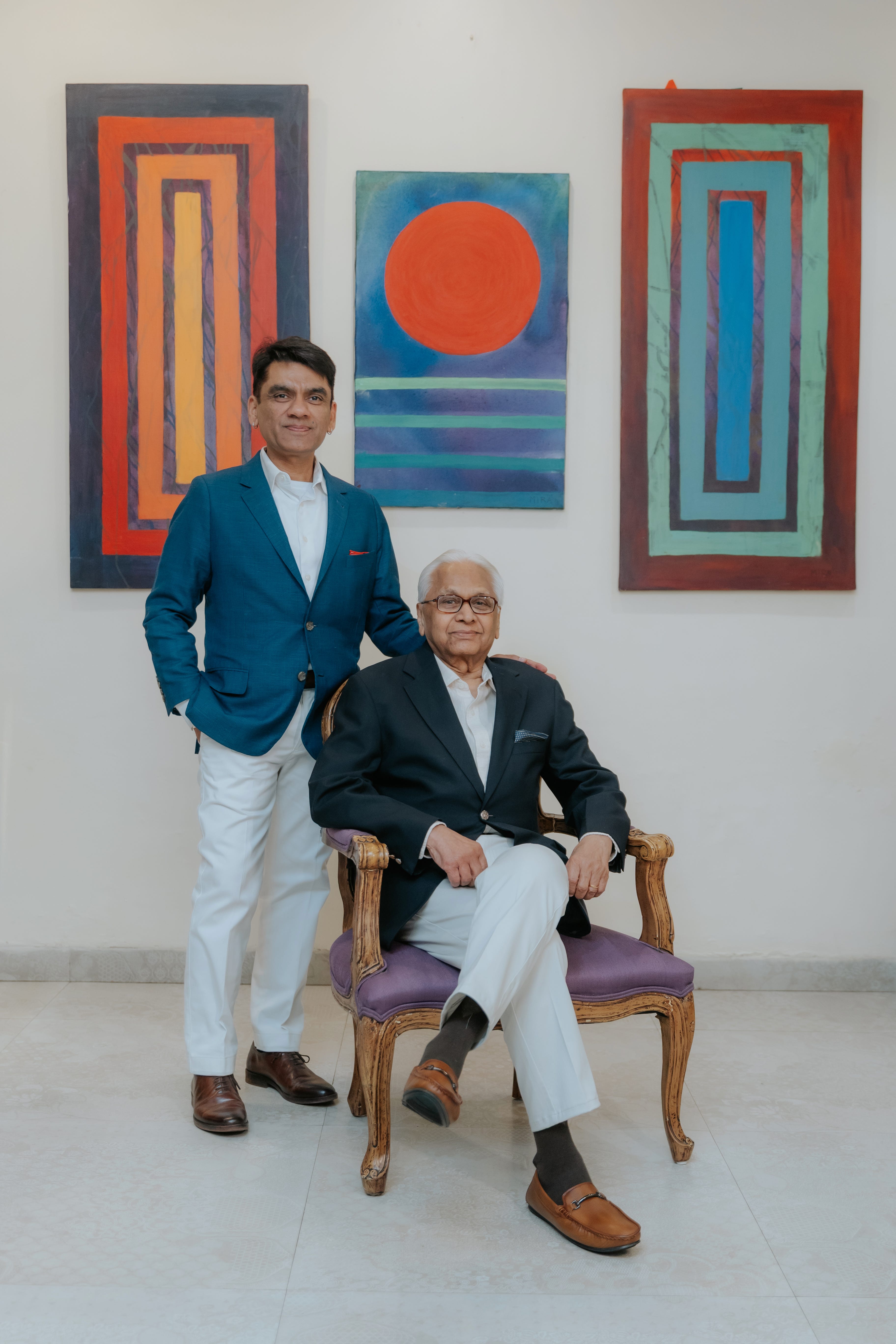
My father is eighty-five.
This morning, at his home in urban India, he woke up, made himself a cup of tea, and eased into the day. After his shower, he sat for a while at the small temple he has put together in his room — a habit he picked up when I was in elementary school, and has not missed since. If you asked him what this ritual meant, he would smile and change the subject.
He has always given more than he had — first time and care, when there was little else; now, also gifts and calls and the kind of love that arrives unannounced.
The first leader many of us ever experience is from amongst our parents – real leadership, the kind that decides what we will later believe a good person looks like and follow into our own adult lives. For men and women alike, the picture of what a good man looks like comes from watching one or two men up close as we were growing up.
That picture lasts. Our partners marry into it. Our children study it before they have words.
Some men inherit empathy. Some inherit violence. Most of us inherit something more complicated. The work of fatherhood is choosing what to keep and what to let go.
It is Father’s Day. So I want to tell you about a book.
• • •
I was twelve – I think. I wanted a particular book that we could not afford that month. I walked into the bookshop with a friend after school on a Thursday, stood with the book in my hand for a long time, and then slid it into my schoolbag and walked out.
I made it home. My father returned from work and saw my face before he saw the book. He always saw the face first.
He did not raise his voice. He did not lecture. He asked me what had happened, and he listened the whole way through. When I was done, he said one sentence: “We will go back, and you will return it.”
I begged him not to make me. He said quietly that this was not punishment — only what needed to happen so I could keep being the person we both believed I was. We went back Saturday morning. The owner was an old family friend, ready to wave the whole thing away. My father would not let him. He told him, in front of me, that this needed to be made right — that I would come for several Saturdays to clean floors and shelves and organize stock.
I spent four weekends in that shop. I learned, much later, that my father had paid for the book the same day I returned it. The debt was settled before my first Saturday.
The work was for me to learn right from wrong.
He did not negotiate with the truth, even for me – Integrity. He made me make it right with my effort and time, not only with words – Accountability. He said something difficult to a kind man who would have let me off – Moral Courage. He never raised himself above anyone in the telling – Humility. He carried himself (and me) without storm or speech, the way he has carried everything for eighty-five years – Dignity. He saw, before I said it, that I had wanted the book because I was ashamed of needing it – Empathy. He drove me there and waited outside for those weekend mornings because his son needed him to – Service. He paid for the book with money that was tight, and never mentioned it – Generosity.
Eight things, from one month, from one man. My father.
• • •
The first time I felt that inheritance moving through me, my daughter was six months old, and we were forty-eight hours into a stretch we were not sure she would survive.
We had been preparing to take her to India to meet her grandfather. There was a list — vaccinations, paperwork, and a prophylactic. A pediatric dose. Somewhere between the prescription and the bottle, an adult dose was given instead. She took it twice before we understood that the way she had gone quiet was not sleep.
By the time my mind caught up with my hands, we were in the ICU. Forty-eight hours, touch and go. Strangers I had never met and would never see again sat with her through two nights, adjusting, watching her, watching the monitors, watching my wife’s face, watching mine.
I had spent the decade before becoming competent at things — how to read a room, build a plan, hold a line. None of it was any use. I could not undo what had been given to her. I could not make a number on a screen rise. I could not pretend to my wife that I was not afraid.
What I could do was sit. I could hold my wife’s hand. I could keep my voice low when a nurse came back with new numbers. I could be, for the people I loved, the still point in a room that wasn’t. At the end of the second night, when she opened her eyes and looked at us as though returning, I let her sleep on my chest the way I had when she was three days old.
I marvel, to this day, at those doctors and nurses. The grit of them. Their expertise. The generosity — strangers giving everything they had to a child not theirs, on nights when their own families were asleep without them. The pill meant to protect her on the way to her grandfather had nearly taken her. What brought her back was the thing her grandfather had been modeling all his life: presence under pressure, given freely, with skill.
That is what my father has been doing all along. The eight things were one thing in different lights — what lets a person be present when there is nothing else to give. He had been showing me, all my life, what to do when competence and confidence run out.
• • •
My daughter is twenty-six now. Her brothers are twenty-three and twenty. They watch with full awareness, the way I watch my father. My wife has lived inside that picture for three decades. We raised our three inside the limits of what we had, the way he raised me inside his — give what you have as though it is all for them, and never claim the giving, so children feel the love and not your limits.
The conversation about what it means to be a man right now is loud and all around us. In one extreme, a man is respected when he is dominant, self-centered and loud — a physically strong and violent engine who will protect his own and will be celebrated for lacking empathy, compassion, and any sense of common good. In another telling, there is a deep suspicion that anything called masculine is a problem for humanity.
I disagree with this entire spectrum of opinion – learning from my first and other great leaders in my life.
To be a man, in the only way worth aspiring to, is neither to dominate nor to disappear. It is to be present, accountable, generous, and steady — and to do it without making the doing a story; to use your strengths, resources, and powers to take care of those in your care — your family, our community, our nation, and our world.
A good man is known by his presence. By what he does on the worst day, in a waiting room, when no one is keeping score.
Happy Father’s Day, Papa!
• • •
Thank you for reading, and Happy Father’s Day!
Adi
This piece reminded me of how my father set a similar teaching into play for me as well. A father’s love is a great exemplification of gentle justice guided by the discerning sword of the heart. Thank you for sharing this piece Adi! Happy Father’s Day to uncle Ji and you!!🥰🙏🏼