

The Delight Gap
From a Hospital Waiting Room

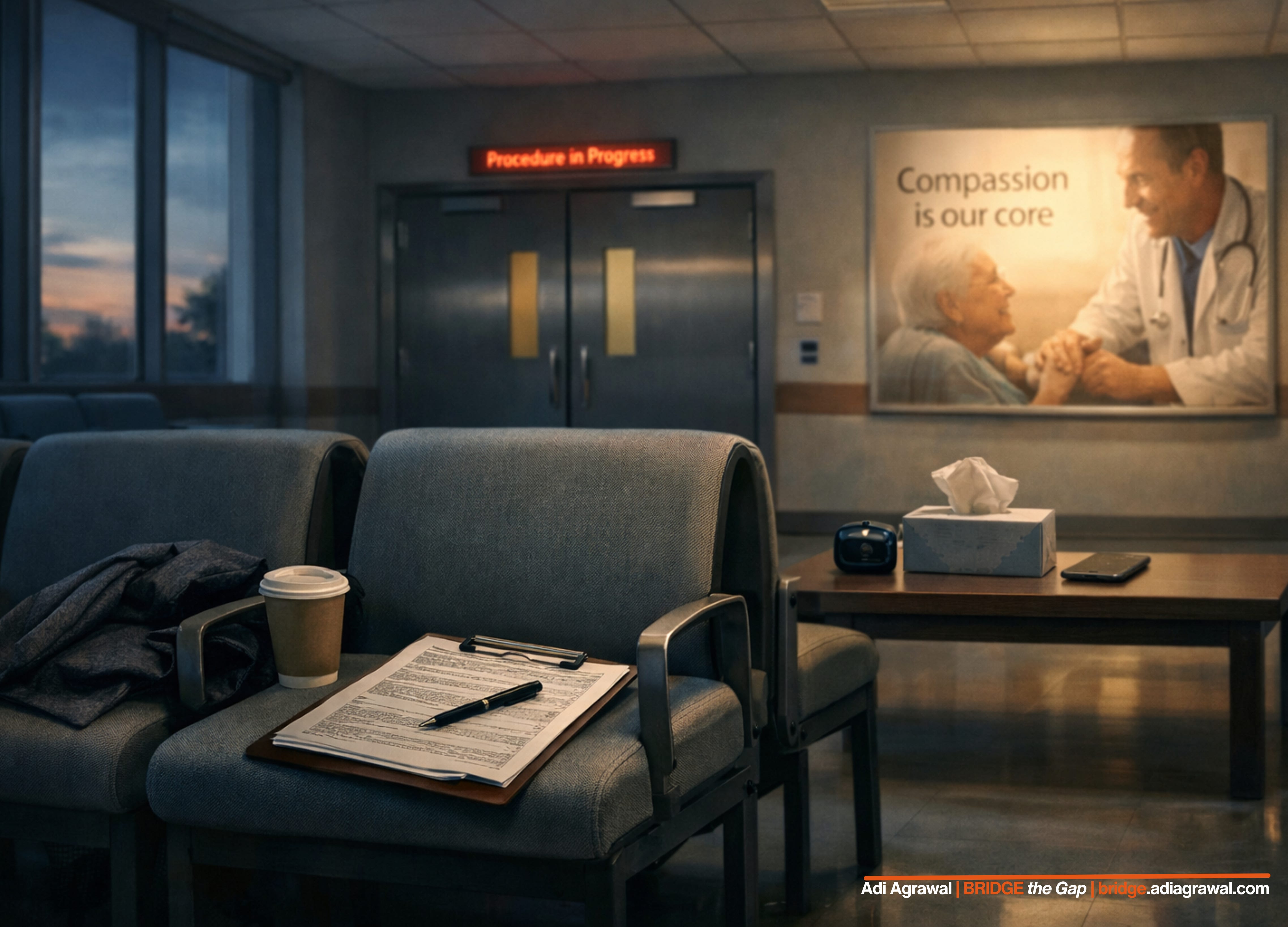
The air in a surgical waiting wing is thin. Scrubbed of everything but the scent of industrial bleach and the low-frequency hum of machines keeping the building alive.
I am sitting in a chair designed for durability, not comfort, watching a clock that seems to have its own relationship with time. An elder in the family is behind those double doors. The surgery is technically routine, but nothing is routine when it involves a person you love. In this room, you aren’t a “Chief Strategy Officer” or a “Founder.” The family is a bundle of raw nerves waiting for a signal.
In this space, the power imbalance is total.
On one side, you have Expertise. The doctors, the surgeons, the specialists – the people who hold the map. On the other side, you have the family. They own the stakes and the fear, but have zero agency. We are outsiders in an opaque process that owns our most precious reality.
On the wall of the lobby is a large, backlit sign. It features a smiling doctor holding the hand of a silver-haired patient. The text is bold and comforting: “Your health is our mission. Compassion is our core. We treat you like family.”
In the business world, we call this a Brand Promise. It is the intangible comfort the customer pays for without regret. They aren’t just buying a surgical procedure; they are buying the feeling of being in safe, intentional hands. That is where Delight lives. It isn’t a freebie or a useless add-on. It is the quiet, profound satisfaction of knowing the institution intends to do right by you.
But as the hours crawl by, the behavior of the institution reveals the reality. The doctors speak in a dialect designed to maintain distance, not to create understanding. When we ask a question about the recovery, we are met with a practiced, evasive shrug. We aren’t being treated like family; we are being treated like a ticket number in a high-volume processing plant, and fear is the lever they are using.
Then comes the “Aha!” moment—the one that should keep every builder and scaler awake at night.
Just as the surgeon stepped out to tell us the procedure was “complete but complicated,” an administrator appeared. She didn’t ask how we were holding up. She didn’t offer a chair. She slid a clipboard across the table with a series of “service authorizations” and insurance waivers. And – she was in a hurry - after all, there were a dozen more families to get papered.
They knew we wouldn’t read the fine print. They knew we couldn’t say no. They knew they were taking absolute advantage of our fear to widen their financial margin.
I call this the Desperation Premium. It is the extra value a counterparty squeezes out of you when they know you have no other choice. In that moment, the Brand Promise on the wall becomes a fiction.
It felt eerily familiar.
For twenty-five years, United Airlines, my hometown carrier, had been my go-to airline - even when the fares were a bit higher. Living in Chicago, they were my default. I flew 100s of red-eye flights, I earned their 1K status for a decade and a half, and I was “all in.” I believed we had a partnership. But over time, I watched the company’s intent shift. The rules changed constantly – often mid-year. The goalposts for loyalty moved exclusively in favor of the company. I was a captive audience. They mistook my long-term habit for loyalty, and they began to charge me their own version of a Desperation Premium. I can only imagine the analysis they’d done to assume that flyers like me, “integrated” into their hub, would never leave, no matter how much the service value eroded.
This is the greatest trap in business, especially for founders scaling at pace: mistaking a “stuck” customer for a “loyal” one.
If you are a builder, you need to look closely at the moments your customers are most vulnerable.
Maybe they’ve integrated your software into the very heart of their operations. Maybe their revenue, their reputation, and their peace of mind are tied to your uptime. They are deeply committed. They are “in the surgery.”
When a crisis hits—when the system lags or the data gets messy—how do you respond?
Too many companies use that moment of deep integration as a cage in which the customer is captive and lacks options. They hide behind opaque SLAs. They use their expertise as a shield to keep the customer in the dark. They see a customer’s desperation as a “high-leverage growth opportunity” to push a tier upgrade or a more expensive support contract.
They think they are being smart. They think they are optimizing for the quarter. But they are actually building a resentment machine.
We need to redefine what we mean by Customer Delight. Many scalers treat delight as a luxury – a “nice to have” once the numbers are settled. They think it’s about freebies or useless add-ons.
They are wrong.
Delight is the emotional result of a Brand Promise being kept every day and especially under fire. It is the intangible satisfaction that comes when a company sees your vulnerability and chooses to protect you rather than profit from it. It is the intent to do right, executed with precision, when the customer has no other place to go.
Trust is the foundation, and Delight is the architecture. You can’t have one without the other. Without trust, delight is just a bribe – a “surprise” gift sent to a customer who knows you’re overcharging them. With trust, delight becomes the reason a customer stays for twenty years – not because they are stuck, but because they wouldn’t want to be anywhere else.
And my warning for all builders and operators is that vulnerability is temporary.
Eventually, the surgery ends. The crisis passes. The “hostage” situation expires. And the moment that customer regains their agency – the moment they are no longer dependent on you for their survival – they will move their wallet and trust.
They won’t just leave; they will find an alternative they can actually trust. And because they felt “managed” rather than “partnered,” they will become your most vocal anti-evangelists. They will tell the world exactly how it felt to be squeezed when they were down. They will explain that while your marketing was about “partnership,” your behavior was about “predation.”
I reached my breaking point with United not during a flight, but during a moment of clarity. I realized that the “Brand Promise” I had paid for over two and a half decades had become a transaction of convenience for them, and a cage for me. They had the expertise, but they had lost the intent.
So, I did what every captive customer eventually does when they regain their agency: I walked away.
I moved my wallet and my trust to two Asian carriers that actually understand the architecture of Delight. They don’t just provide a seat; they provide the emotional comfort of a promise kept. They understand that every flight is an opportunity to earn trust, not an opportunity to apply leverage.
Switching after twenty-five years wasn’t about the seats or the miles. It was about finding a partner that wouldn’t charge me a Desperation Premium the next time I needed them.
The modern customer is smarter than the institutions give them credit for. They can smell the difference between a partner and a predator from a mile away. They know when your “Customer Success” department is just a “Retention Bully.”
The Value Gap in the hospital that day was the distance between the sign on the wall and the woman with the clipboard. It was a gap created by a lack of intent.
Our elder got the care she needed, but the hospital never earned her trust. Like every business, there were superstars and compassionate, caring people, and unlike a brand promise, they were the exception. She is recovering. The physical wounds will heal, but the memory of being “handled” instead of “served” will remain.
Every leader needs to ask: Are we building a brand, or are we building a cage?
Are we earning trust every day, or are we relying on the fact that it’s currently too hard for our customers to leave?
Build for the human. Earn the trust in the moments of vulnerability so that you can sustain delight in those moments of growth or fire. Taking advantage of a customer when they are down might look good on this month’s income statement, but trust is the only thing that ensures there is growing income and growth on the balance sheet.
Surprisingly, keeping brand promise costs less and earns more.
Enjoy your loved ones and the rest of your day. Especially the quiet moments. They are more fragile than we think.
And thank you for spending some of it with me.
Warm regards,
Adi