


This is our last Sunday together in 2025, and I’m not going to end the year by telling you to “crush 2026,” because most of us are tired of being told to crush anything when what we really want is to sleep through the night, stop snapping at people we love, and feel like our life belongs to us again.
So here’s the gift instead: a seven-day series of LinkedIn posts, each one linked to a small tool you can do in ten to twenty minutes. I started this series yesterday, Saturday, December 27, and it runs through January 2, built for the moments when the year ends and you realize you’ve been running a little too hard with your head down, and you’re not sure what you’ve been trading away to stay “on track.”
The tools are plain on purpose. They don’t require a new identity, a new planner, or the kind of public announcement that quietly turns personal change into performance. They exist to do one thing well: help you regain clarity, which is the beginning of calm.
I built these because I needed them.
The Night the Year Felt Like a Blur
The first reset happened on a December night some 16 years ago in a Chicago suburb. The kind of winter night where the city feels like it’s holding its breath, and inside the house, you can hear every small sound.
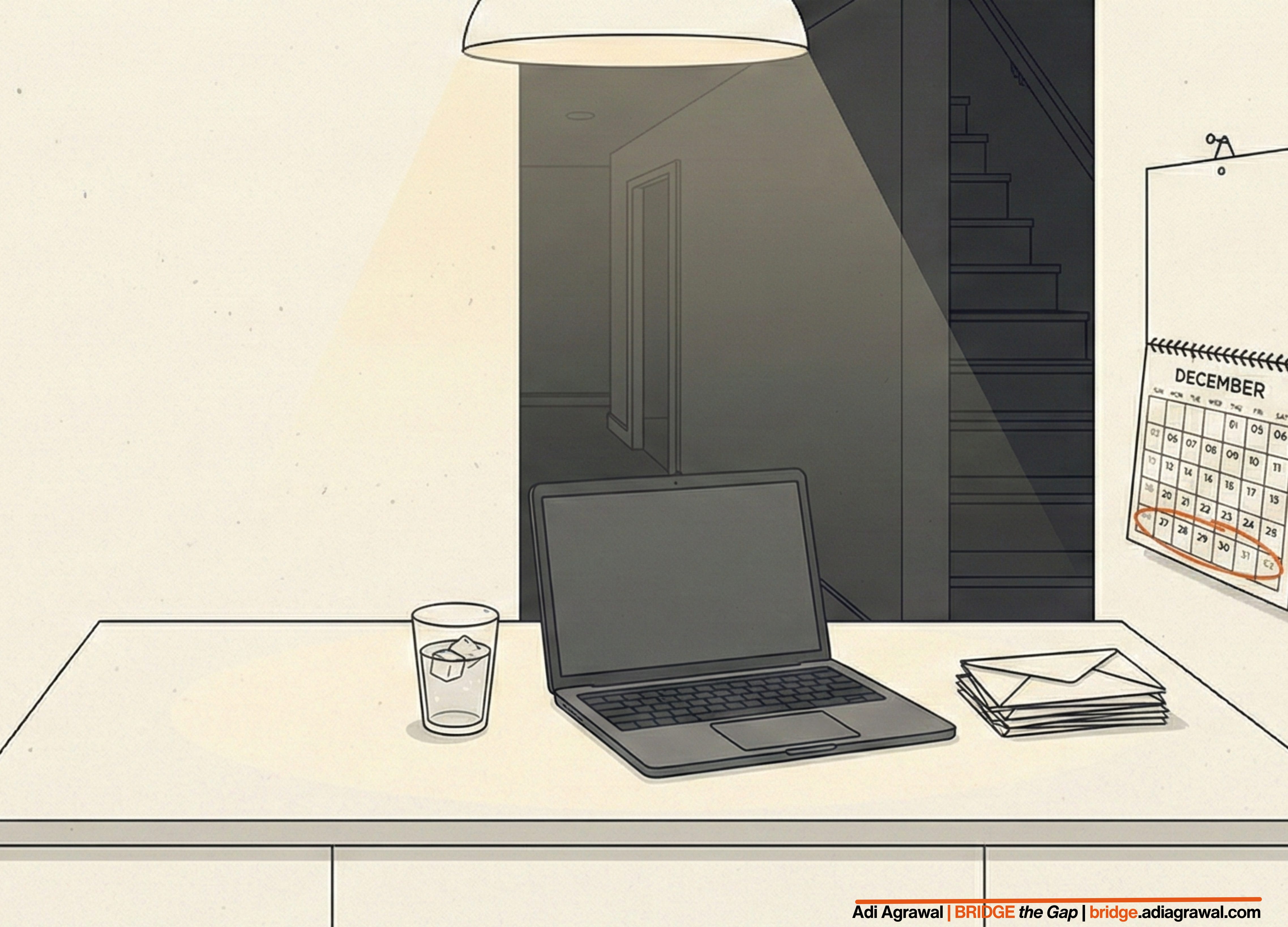
I was in the kitchen, and the details are embarrassingly normal: a half-loaded dishwasher, a stack of mail, a laptop that had been open way too long, and a quiet upstairs where my wife and kids had already moved on from the day.
I remember looking at the calendar and realizing the year was basically done, and yet I couldn’t tell you what the year had been – busy, productive, frustrating?
I had that familiar sensation of being fine while feeling something was vaguely wrong. A dangerous condition because there was no emergency, no obvious villain, no clean excuse, and the only honest explanation left was the one I didn’t want: I had been trading pieces of myself for motion, and the trades had become so routine, I had stopped noticing.
I stood there long enough to feel the discomfort, and then I did what I often do when discomfort starts, asking good questions: I looked for something else to do.
Not to fix the year. Just to get clear.
That’s the origin of this entire seven-day reset, and I’m telling you that up front because there’s a lot of noise right now about discipline and hustle and becoming your best self, and in my opinion, the truth is more mundane: I built this because I needed a way to stop lying to myself about the life I was living.
How the Tools Were Born
The first version of the reset wasn’t seven parts. It wasn’t even a method. It was one sheet of paper, a pen, and a promise not to perform for anyone, including myself.
I started with what I now call the inventory day. At the time, I had no idea what was real anymore. I knew what I told people was real, and I knew what I wanted to be real, but I didn’t know what was actually happening inside the most important areas of my life. It’s the kind of ignorance that makes people successful in public and miserable in private.
So I wrote down the same six domains I kept hearing people talk about in polite conversation, the ones we all claim we care about while we quietly neglect them: family, physical health, emotional life, mental attention, money, and work. I didn’t write goals. I wrote facts, and the constraints that mattered – no negotiation.
I wrote down what was true about my family life that year, including what I didn’t want to admit, which was that I had been home and absent at the same time, and that my “I’m listening” face had become a kind of professional mask I could wear while my mind stayed elsewhere.
I wrote down what was true about my body, including how much I had been treating fatigue like an acceptable cost of adulthood, and how quickly I would ignore a warning signal if a meeting invited me to pretend I was fine.
I wrote down what was true about my attention, because attention is where drift starts, and I could see how my mind had turned into a place where every urgent thing in the world could barge in without knocking.
I wrote down what was true about money because money isn’t the point, but it does tell you what you’re afraid of. I could see exactly where I had been avoiding clarity because ambiguity is comforting until it starts costing you in real terms.
And I wrote down what was true about work, including the part that stung, which was that I was doing a lot of things that looked like progress and felt like fear.
That single inventory page was not inspiring. It was sobering, and it was the first time in a while I felt like I was dealing with my actual life instead of the story I was telling about it.
The second tool came later, and it became similar to the essay you are reading today (Sunday, December 28), because I realized the inventory only works if you understand your patterns, and patterns don’t reveal themselves through willpower; they reveal themselves through story.
I started collecting stories without meaning to, because over the years I kept seeing the same human failure mode in different cities, in different cultures, in different corporate settings, and even in different families: people can endure almost anything when they believe the tradeoffs are temporary, but they start breaking down (often quietly) when the tradeoffs become normal.
I saw it in a Dubai workshop where a junior person stayed silent the entire day while senior leaders debated strategy like sport, and then in a hallway he said one sentence that was more accurate than everything we’d spent hours discussing, and he said it the way people speak when they’ve learned that being right isn’t rewarded if you don’t have the right to speak.
I saw it in a Gurgaon office where everyone was moving fast, and the person who actually held the system together was an office manager who knew every dependency and every quiet failure point, and watched leaders ignore her warnings because her voice didn’t come with a credential or a title.
I saw it in my own house when my kids would ask a simple question – something like “are you coming?” – and I would answer “in a minute” in the same tone I used in meetings, which is a particular kind of self-deception because it turns the people you love into another queue.
Those stories became the second day of the reset because stories are where I learned to catch myself. I realized that if I can’t tell the truth about how I got here, I can’t change how I keep getting here – and how to get to where I really needed to be.
The rest of the tools evolved the same way, not from theory, but from repeated damage.
The physical day exists because I noticed that most of my worst decisions were not intellectual failures; they were energy failures, made at the end of a day when my body had been trying to negotiate with my ego for hours and finally gave up.
The relationship day exists because I realized that nothing corrodes trust faster than a leader – at home or at work – who avoids small repairs, and then tries to make up for it later with a grand gesture. I realized that people don’t feel loved by gestures; they feel loved by reliability.
The attention day exists because I watched myself become more reactive than curious, and I didn’t like what that was doing to my character, because it made me sharp in all the wrong ways, and it made me underestimate the people around me, especially the quiet ones.
The money and career day exists because I’ve spent enough time around smart people to know that anxiety loves vague plans, and clarity – the real, insanely radical kind of clarity, the kind that includes numbers and dates and uncomfortable constraints – is the quickest way to calm our nervous system without pretending.
And the tracker day exists because I have learned the hard way that intention is not a strategy; intention is a feeling, and feelings are unreliable because when you’re tired, you default to old habits.
A reset that can’t survive a normal Tuesday is not a reset.
What I Do Now, When I Feel Adrift
By now, I can tell when I’m drifting. The signal is rarely “I’m overwhelmed.”
The signal is more subtle and more damning: I start treating people like tasks, I start treating my body like a machine, I start treating my attention like it belongs to the least productive uses, and I start spending time with people who devolve missions into failures. And most remarkably, I start treating time as something to spend rather than something to live in.
That’s when I run the reset. I don’t run it because it makes me feel virtuous; I run it because it makes me honest, and honesty is the only thing that gives me leverage over my own life.
This seven-day series is the condensed version of what I’ve used for years, refined by repetition, bruises, and the occasional uncomfortable conversation that should have happened sooner.
If you do it with me, you’ll see the pattern quickly: the first days are about seeing clearly, the middle days are about protecting what matters, and the last day is about not letting the whole thing evaporate once the calendar flips.
That’s it. No reinvention. No performance.
Just a structured way to come back to yourself – honestly, clearly, with conviction.
A Nudge and a Question
If you only take one thing from this, start with the simplest part (I shared this on Saturday, December 27, on LinkedIn), do the inventory, and write what is true without trying to fix it in the moment.
Then follow along and apply the Sunday for the story tool, because once you can name your pattern without flinching, the rest becomes less like self-help and more like self-respect.
And here’s the question I want to leave you with at the end of this year, because it’s the one I keep having to answer myself:
When you look back at 2025, are you proud of what you achieved, or are you proud of who you became while achieving it?
Enjoy your loved ones and the rest of your Sunday! Thank you for spending some of it with me.
My best wishes for a wonderful 2026.
Warm regards,
Adi
.S. In addition to the links in the opening and closing sections of the essay above, here are the links to all 7 LinkedIn Posts in the 7-day reset series referenced above.
Day 1: Inventory the Reset
where is the link? like where is the framework for the said reset? what did I miss