


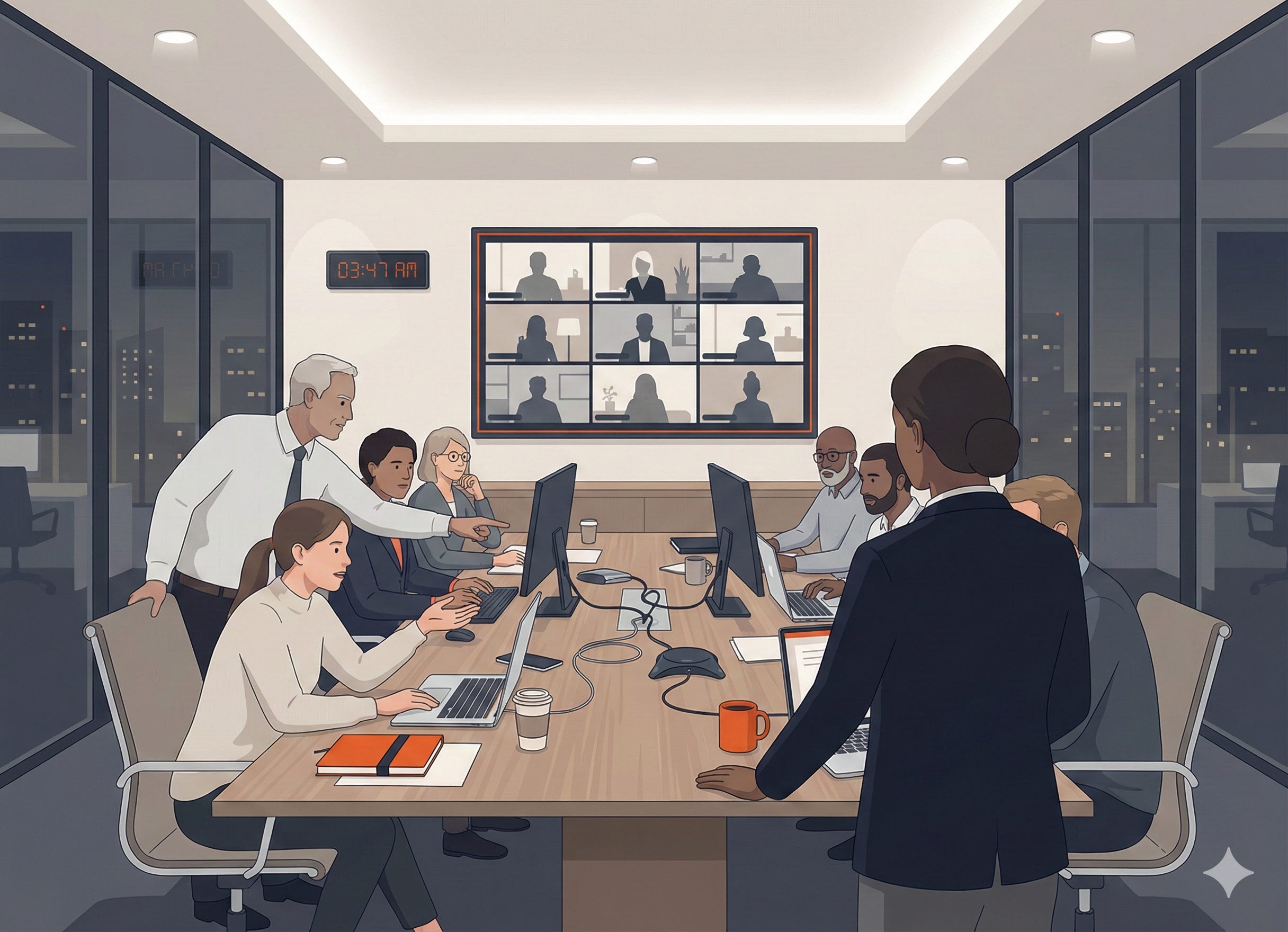
The outage didn’t arrive with drama. There was no shouting, no alarms blaring, no movie-style chaos. It started the way most serious problems in large systems do: quietly, in the wrong hour, when everyone’s already tired and the coffee’s already stale.
By the time I got to the office, the war room was full. Screens along the wall were glowing red in that particular shade that makes your stomach tighten. New York was awake and impatient. London had stopped bothering with polite phrasing in their emails. Somewhere in Asia, a client was hinting at moving their business if this wasn’t fixed quickly. The room was a mix of tense silence, fast typing, and the dull hum of the air conditioning.
I walked in, dropped my bag, and felt something rise in my chest that I had felt many times before: this is the moment. This is where I earn my title.
I didn’t raise my voice. I didn’t have to. The room made space for me; it always did. I stepped into the middle of it and did what I had trained myself to do.
“Who owns this right now?”
“How long have we been down?”
“What’s the rollback plan?”
Questions came out of my mouth like instruments laid out on a surgical tray. Sharp, efficient, and a little cold. Someone started to explain how we had ended up here, and I cut him off. “I don’t need the story yet; I need the fix.” A junior engineer, halfway down the table, inhaled as if she was about to speak. Then she glanced at her manager, kept her eyes on the keyboard, and didn’t say a word. I noticed the movement but not the meaning. In my head, I was being decisive. Focused. Strong.
We fixed the incident before the next business day opened. Systems came back. The trading screens unfroze. The angry emails softened. There was a recap, an apology to clients, a slide or two with timelines and root causes. On paper, the whole thing could be filed under “well-handled crisis.” The company moved on.
I didn’t. Not really. I carried a quiet pride around for a few days, a private story about how I had stepped in, taken charge, and done what protectors do: hold the line when everyone else is under pressure. A few days later, my HR partner knocked on my door with a folder in her hand and closed the door gently behind her.
She sat down, laid the stack of debrief notes on the table, and said, “Overall feedback from the incident team is positive. People appreciated how quickly things moved.” She hesitated, which was my first clue that this would not be a simple conversation. Then she slid one printed page toward me.
“There’s one comment I think you should see for yourself, Adi.”
The paper felt heavier than it should have. I remember the faint smell of toner, the dull light coming through the blinds, and footsteps in the hallway that suddenly sounded far away. In the middle of the page, one comment was highlighted:
“When he walks into the room, I stop talking.
In a crisis, I’m more afraid of saying the wrong thing
than of the system going down.”
No name. No role. Just that sentence, sitting there like a verdict.
My chest tightened. I read it once. Then again. I felt my mind reach for the usual defenses. They’re overreacting. It was a high-stakes incident; everyone was on edge. My job is to fix things, not manage feelings. If people are scared, that’s the cost of excellence.
Underneath all of that, another quieter voice cut through: if the people closest to the problem are more afraid of you than of the actual failure, are you really protecting them? Or are you protecting your image of yourself as “the strong one”?
That question took me to a place I didn’t like to visit.
I had spent years telling myself a story about who I was in a crisis. I was the protector. The one who stepped into chaos, took the weight off everyone’s shoulders, and made the hard calls. I believed intensity was service, and urgency was love.
But protectors don’t make the people they care about go quiet. Performers do. And at that moment, I had to admit to myself that my strength might be manifesting as fear, not safety.
Some of that came from home. Growing up, the protector in our family was my father – steady, serious, and exhausted more often than he would admit. When problems hit, he shouldered more, slept less, and spoke in shorter sentences. You knew he loved you, but you also knew that when he was in that mode, your job was not to burden him with one more thing. I admired that. I copied it. I carried it into boardrooms and war rooms and started confusing control with care.
The next serious incident didn’t wait for my emotional processing to complete. These things never do. It arrived on a different night with a different set of alarms, another room full of tired people, another client threatening consequences. I walked in and felt my body reach for the old script: take charge, tighten your tone, narrow the conversation to answers, not theories.
This time, I stopped myself.
“Before I say anything,” I told the room, “I want to hear from the people closest to the problem. Let’s start there.”
And then I kept my mouth shut.
The silence felt longer than it probably was. People shifted in their chairs. A woman on video from another country looked visibly unsure if she should speak or wait for her manager to interpret. I could feel my own impatience rising – every second felt expensive – but somehow, due to some unspoken grace, I held the line.
“You’re closest to it,” I said. “Walk us through what you’re seeing.”
She started cautiously, choosing her words like stepping stones. When she saw that I wasn’t interrupting, her voice steadied. She pointed us toward a subtle configuration issue most of us had skipped over in the rush. Her perspective saved us hours and likely saved a client relationship. In my old mode, I would have rolled past her and missed it.
The recap email that night looked different, too. Instead of centering my decisions, I named hers. I wrote about the value of someone close to the problem speaking early and honestly. No one congratulated me for “owning the room.”
That felt like progress.
From there, the work was less about dramatic transformation and more about quiet rewiring. In tense meetings, I forced myself to go last. I made it a rule to ask at least genuine questions before offering an opinion. I said out loud, in front of my teams, that raising a concern in good faith – even if it turned out to be a false alarm – would never be treated as disloyalty. It would be treated as protection.
At first, it felt slow and awkward. Old habits tugged at me, especially when the stakes were high or sleep was short. But slowly, the rooms began to change. People brought bad news earlier. They voiced half-formed worries that later turned out to be important.
The silence I used to read as alignment revealed itself for what it often is: fear.
There was another layer to all of this – one I had largely ignored. My teams were spread across Chicago, London, Dubai, Bangalore, Singapore. Different passports. Different relationships to authority. In some cultures, challenging your boss in a meeting is a career risk. In others, it’s expected. For a long time, I had run global meetings as if my own style – Indian-born, US-trained, comfortable with direct debate – was the default setting and everyone else was an adjustment around it. That was its own quiet form of arrogance.
If I truly respected “otherness,” it couldn’t stop at food, holidays, and the right words on a slide. It had to show up in the design of the room. So I started asking for written input before major decisions, especially from those in other time zones who might not feel comfortable jumping into a fast-paced live conversation. I rotated who spoke first so it wasn’t always the native English speaker in HQ. I repeated, more times than I thought necessary, that speaking about risk early was an act of protection, not betrayal.
What came back was not just more voices – it was measurably better thinking.
The edge case no one in Chicago had considered came from Dubai. A cultural nuance that changed a rollout plan came from Singapore. A quiet engineer in Bangalore flagged a dependency that would have bitten us six months later. Global citizenship stopped being an abstract value and became something simpler and harder: letting other people’s reality change mine.
I wish I could say I never slip now. That would be another performance. I still have moments where my tone sharpens, and my questions come out like weapons instead of tools. The difference is that now I notice it. I repair faster. I go back and say, “I handled that badly. Let’s try again.”
And in the back of my mind, I still carry that anonymous sentence like a small, heavy stone I don’t want to forget:
“When he walks into the room, I stop talking…”
I never want to earn that line again.
These days, before I walk into any room – a war room, a boardroom, even my own living room – I take a breath and ask myself a simple question: when I enter, will people feel safer to tell the truth, or more careful to stay silent? If the honest answer is “more careful,” that is my work to do, not theirs.
If this feels uncomfortably close to your own story, it doesn’t mean you are a bad leader. It might mean you are standing right at the edge of a different kind of strength – the kind that doesn’t need to dominate the room, only to make it safer. You don’t need a grand program to start. In your next tense meeting, let the person closest to the problem speak first. Ask a few real questions before you supply opinions. Say, plainly, that you will not punish honest bad news.
Then pay attention to what happens when your presence stops being a spotlight and starts becoming a shelter.
That shift – quiet, often invisible from the outside – is where real protector energy begins.
Enjoy your loved ones and the rest of your Sunday!
And thank you for spending some of it with me.
It’s good to be back in your inbox after a gap of two wonderful weeks – traveling in Asia – more stories on that soon. I promise.
Warm regards,
Adi
Extremely well written as usual!
"For a long time, I had run global meetings as if my own style – Indian-born, US-trained, comfortable with direct debate – was the default setting and everyone else was an adjustment around it. That was its own quiet form of arrogance."
Very well said!