

Waiting Rooms
Is Your Process A Queue And What to Do About It

TL;DR — A synthetic story from my real corporate-executive experience. Five years ago, I watched a process consultant map a deal pipeline with the leader who ran it. Fourteen boxes, three branches, two loops. When she made him answer how long each step actually took, the math became impossible to look away from: thirty-one minutes of value-creating work sat inside three and a half days of calendar time. Less than three percent. The rest was waiting and rework. Most organizations have a workflow that runs like this and have stopped seeing it. The framework (value creating, wait time, rework) is the one I use to find the gaps and close them. Use the mini-guide at the end as a handy reference.
• • •
I watched Sofia draw boxes on a whiteboard for the first time about five years ago. She was sitting across from Marcus, who runs a deal pipeline.
Sofia had written a single sentence on the board: “Walk me through a deal. First contact to contract. Every step.” And she meant every step – not the version from a process doc, but the real one, including all the parts that live in someone’s head.
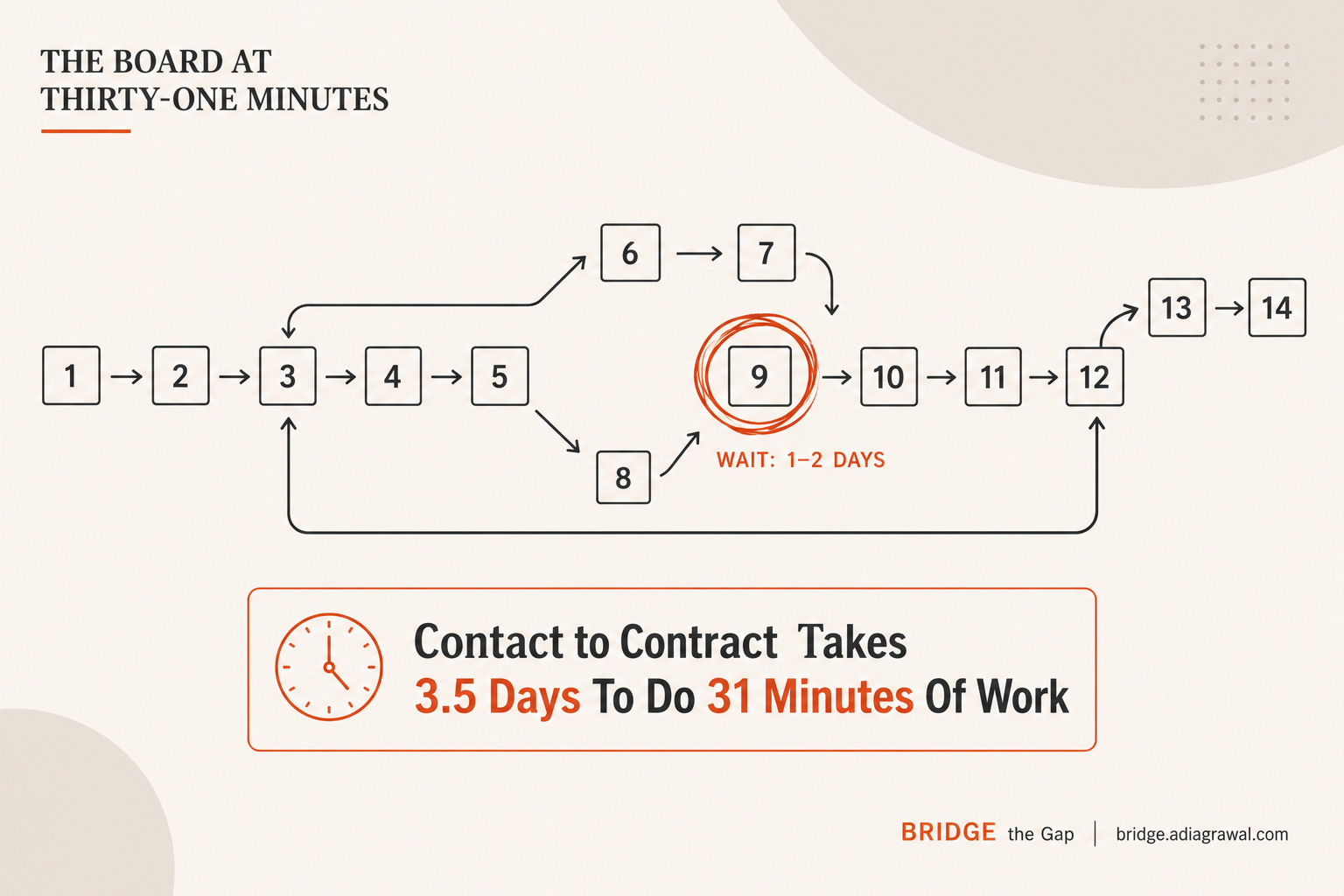
Marcus started talking. Sofia drew a box for each step, arrows between them, and branches for the “unless” and “if they” moments. By the time he finished, there were fourteen boxes on the board. Three branches. Two loops where a step fed back into itself.
Then she asked: “How long does each one actually take?”
Marcus knew some precisely, some approximately, and some he had to think about. But when he got to Step 9 – a handoff that depended on whether a specific person was in the office – he said: “It waits. Usually a day, sometimes two.”
Sofia circled that box twice and kept going. When she was done, she stepped back and looked at the board in silence.
Fourteen steps. Thirty-one minutes of actual human touch time – calls, data entry, document preparation, the things that actually moved a deal forward. Calendar time from first contact to signed contract: three and a half days.
“Three point five days,” Marcus said slowly.
“For thirty-one minutes of work,” Sofia answered.
• • •
Most organizations never do what Sofia did that day. They have processes – or they think they do. They have documented workflows, assigned owners, and tools and templates. What they don’t have is a map of the distance between the work that matters and the time it actually takes.
Sofia’s framework is simple. Go through every step and every gap between steps and ask one question: is this time value-creating, wait time, or rework?
Value-creating is the work that moves the deal. The judgment calls. The decisions. The things you couldn’t automate without breaking something important.
Wait time is everything, sitting in a queue. In an inbox. Waiting for approval, waiting for another team, waiting for one person to be in. That Step 9 in Marcus’s process – the one that depended on Tina being at her desk – that was wait time. A day or two, every deal, every time.
Rework may be information being re-entered somewhere it has already been entered. Data needed to be keyed in twice because systems don’t talk. A document reformatted because it came from a source system nobody trusts. It looks like work, but it is work you are that is being redone.
When Sofia and Marcus classified every step and every gap, they found that thirty-one minutes of value-creating work sat inside roughly eighteen hours of wait and rework. Less than three percent of the time that actually mattered.
Marcus looked at the board in wonder.
Then, after a pause, he said, “It’s not a process. It’s a waiting room.”
• • •
You probably have a waiting room in your business right now. You have learned to accept it as normal. You have built your expectations around it. You have hired people to manage around it.
The biggest gains I have seen – across financial services, technology, software companies, professional services, manufacturing, anything with a workflow – come from removing the waiting, not from working faster.
The waiting traces back to the same few sources. A critical step depends on a specific person being available – Marcus and Tina, every deal, every time, and nobody calls it a problem anymore because that is just how deals work here. Information moves through multiple systems or gets checked at multiple gates before it can progress. A decision that should happen in minutes gets routed into a queue where it sits for hours or days.
Wait time is invisible until you draw it out. You can look at a deal that takes three and a half days and think, “That is just how long deals take.” You can’t change what you can’t see. But the moment you map it – the moment you write “WAIT: 1-2 days” next to Step 9 – you are no longer dealing with an acceptable part of business. You are dealing with a structural problem that has a solution.
The solution is rarely a single move. Tina’s step could be done by someone else, or earlier in the week when her calendar is lighter, or in parallel with another step, or by a script. Sometimes the real question is why the step exists at all.
Sofia’s framework does not prescribe the answer. What it does is make the waste visible.
And visible waste is the only kind that can actually be reduced.
• • •
What is the one workflow in your organization that runs constantly, that touches every customer or every revenue dollar – the one whose speed matters more than almost anything else?
When did you last walk through it from beginning to end, step by step, with someone who actually does it?
And when you do, what are the boxes you will circle twice?
• • •
Please do take a moment to share your thoughts, comments, likes, and questions.
Enjoy the companion field-guide included below.
Thank you for reading,
Adi
• • •
Field-Guide
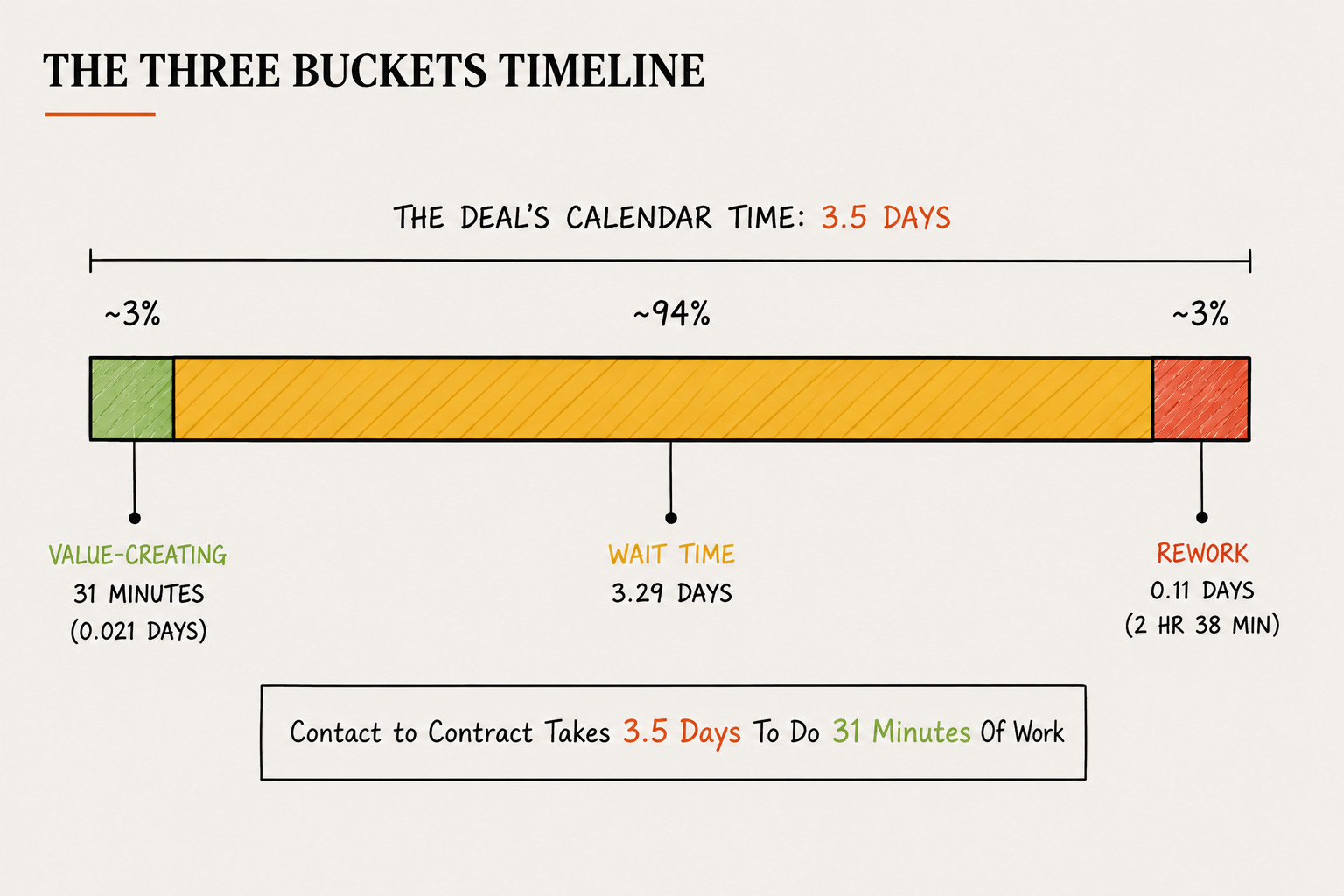
Value-creating – judgment, decisions, work that actually moves you to outcomes.
Wait time – queue, inbox, approval, another team, a specific person being available.
Rework – the same information re-entered or re-formatted, any work that has been done before, and all or parts of it will be done again.
The test:
Classify every step and every gap. In most workflows, less than five percent of elapsed time is value-creating. That is where your opportunity is.
• • •