

One True Life

• • •
That first Thursday, Angie almost didn’t go up.
She stood at the bottom of the stairwell for a while, her mother’s text still open on her phone — Please. Just once. For me. She climbed the stairs. Her movements clearly reflected that she’d already decided that this was a waste of time, and she was doing this for her mom.
The room at the top was small and warm. Books on every wall, a single lamp instead of the overhead light, and beyond the window the early dark of late November. People called him the Sensei. Angie didn’t know if that had ever been a real title or just a name that stuck. It didn’t matter to her.
“My mother thinks you can fix me,” Angie said, before she’d even sat down. “I told her there’s nothing to fix. I’m just behind.”
“Behind whom?”
“Everyone.”
She sat down at last, on the edge of the chair, as if she might still leave. “I went to Minnesota. Economics and Philosophy. You know what people do with that? Consulting. Strategy. Grind for two years, get into a good graduate program, make real money. Everyone I graduated with is already on their way. I’m the only one sitting here.”
“Your mother said you’d worked. Internships?”
“Two.” Angie almost laughed. “One paid. A tech consulting firm. It was boring and easy – but mostly boring. I picked up a certification in a few weeks, and they’d have probably wanted to keep me. I couldn’t – I just did not feel or taste anything.”
“And the other?”
She was quiet for a moment. “A music production company. Unpaid. I sat in on sessions with musicians — confident ones, and terrified ones pretending they weren’t. There was one singer who couldn’t find his take – all session, and I said something to him, I don’t even remember what, and suddenly he was alive. The whole room was alive.” She could hear herself getting excited, and it embarrassed her. “But you can’t tell your family that’s what you want. ‘How’s the job hunt, Angie?’ ‘Great. I’m trying to make strangers feel alive in a room. For free.’”
The Sensei smiled, but didn’t laugh. “Then why did you come tonight, if there’s nothing to fix?”
“Because Mom asked me to.” She stopped and then added, “And because I’m tired. I wake up, and I can’t even start. I open my laptop and close it again. I’ve stopped wanting to meet all these relatives and my parents’ friends.”
“Then we won’t fix anything,” the Sensei said. “We’ll just talk. Come back Thursday if you want to. Don’t, if you don’t.”
• • •
Walking home, Angie told herself she wouldn’t go back.
She went back.
Not because she thought it would work. She just didn’t want another message from her mother – and somewhere in that week, she stopped being so sure it had been a waste of time.
She skipped the third Thursday out of spite and spent the whole evening more miserable than usual. By January, she was climbing the stairs without anyone having to ask her.
The hardest evening came in the middle of winter, snow stacked on the window ledge, the city quiet under it.
“I just want someone to give me the answer,” Angie said, angrier than she meant to be. “Make music, or don’t. Take the safe job, or don’t. Everyone says, ‘follow your passion’ or ‘be realistic,’ like those are directions. I don’t need a pep talk. I need to know which one is right, so I can stop feeling like this.”
“Which one is right?” the Sensei said, slowly. “You think there’s a single correct life. That everyone else found theirs, and you lost yours somewhere.”
Angie’s eyes stung. “…Yeah. That’s exactly it.”
“Then of course you can’t move. You’re not choosing a path. You’re trying to guess a secret – and if you guess wrong, you’ve ruined the one life you were supposed to get right.” The Sensei leaned in, and his voice was kind. “No wonder you can’t start.”
Angie didn’t say anything for a while. No one had ever put it that way before, but that was exactly how she felt.
• • •
“Let’s forget which one is right,” the Sensei said.
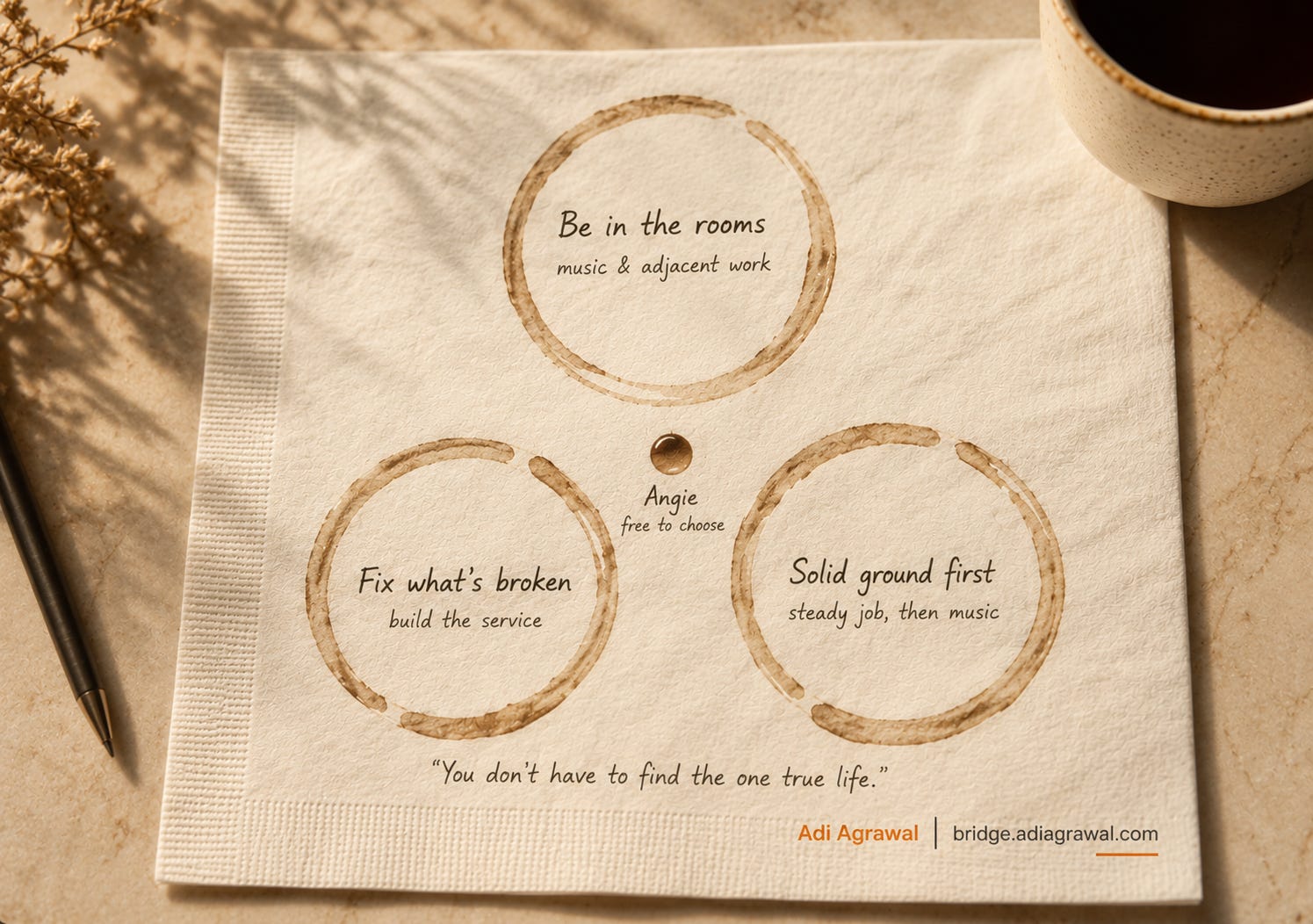
“If you only wanted to move toward work that makes a room come alive – not the whole journey, just one step toward it – what could you do? Not what you should do. What you could.”
“I don’t know.”
“You do. You know this world. I don’t. Humor me. One way.”
Angie let out a breath. “…I could call people. I still know a few from that summer – don’t know if they will remember me – there are some names I have collected over the years. I could ask about music work, or anything close to it. Coordinating. Helping run sessions. Even the boring jobs nobody wants. At least I’d be in those rooms.”
“That’s one. It took you four seconds.” The Sensei waited. “Another.”
“I—” She stopped, surprised at herself. “That summer, I kept noticing how badly the business runs. Scheduling, session logistics, all of it held together with tape. I used to think someone could build a real service for it. I could find out what they actually pay for and build something better. I have this habit of seeing what does not work – fix the worst of it.” She blinked. “I have the mind for that – or I could learn how to get someone to do that for me.”
“That’s two – and you came alive more on that one than the first. Worth noticing.” A small smile. “One more.”
“…Or none of it yet.” She said it slowly. “Take a solid job. Any honest job. Make some money, stop lying awake about being stuck, and build up the nerve. Then walk toward music from a steady ground.”
“That’s three. You came up with all three in five minutes, with no help from me.” The Sensei sat back. “So tell me honestly. Which of those three do you think you cannot do?”
Angie opened her mouth, then closed it.
“None of them,” she said quietly.
“None of them,” the Sensei said. “You can do any of the three. You always could. That was never the problem.”
“Then why have I been frozen for more than a year?”
“Because you’ve been waiting to feel certain before you move. You think confidence shows up first, and then you act. It works the other way around.”
The Sensei tapped the table once. “You were never short on clarity – look how fast those paths came to you. And you were never short on ability. What you didn’t do was permit yourself to choose one without a guarantee. To believe that picking a good direction, and being free to change your mind later, isn’t the same as failing.”
“What if I choose wrong?”
“Then you’ll be a capable young woman on a path she can change – instead of a capable young woman who is stuck in place.” He said it warmly. “You don’t have to find the one true life, Angie. You just have to pick a real direction, trusting you’re strong enough to walk it, and strong enough to turn around or change it if you need to.”
• • •
The last Thursday Angie went was in early spring. The snow had turned to slush, and the light stayed in the window a little bit longer.
She never told the Sensei which of the three she’d chosen.
She had chosen – you could see it in the way she sat. She’d stopped perching on the edge of the chair a while ago. But the choice was hers now.
“I don’t think I’ll need Thursdays anymore,” she said. She didn’t say it like an apology. She wasn’t scared, either.
“No,” the Sensei said. “I don’t think you will.”
At the bottom of the stairwell, Angie stopped for a second, the way she had that first night in November. Then she pushed the door open into the brisk spring evening, took out her phone, and made a call. And whatever she said when the other person picked up, she said it like someone who knew she could.
• • •
Thank you for spending some of your day with me.
Enjoy your loved ones and the rest of your day.
Warm regards,
Adi