


This is a fictional story.
The company, names, and conversations are constructed. But the patterns are real.
Over the years, I’ve worked inside leadership teams where culture was shaped quietly, through tone, signals, and small decisions that rarely showed up in formal policy. Many of those experiences are confidential.
So I write through a composite version of myself.
Meer Singhal is not one person. He is an observer, a participant, and sometimes a challenger, drawn from years of watching how leadership teams actually behave when the stakes are real.
This story is not about any one company. But if you’ve spent enough time in executive rooms, it will feel familiar.
And now the story…
By the time I spoke, the room had already decided to move on.
Chris Gill was at the head of the table, jacket off, sleeves neat, one hand resting beside a stack of briefing papers he did not need to look at. The quarterly business review had the controlled feel these meetings often take on once a Chief Executive Officer has been in place long enough for people to stop speculating and start adjusting themselves around them.
The numbers were solid. Not brilliant, not weak, just solid in the way boards tend to reward: margins up, costs contained, no public embarrassment, no visible disorder. The slides were clean. The commentary was dull but familiar.
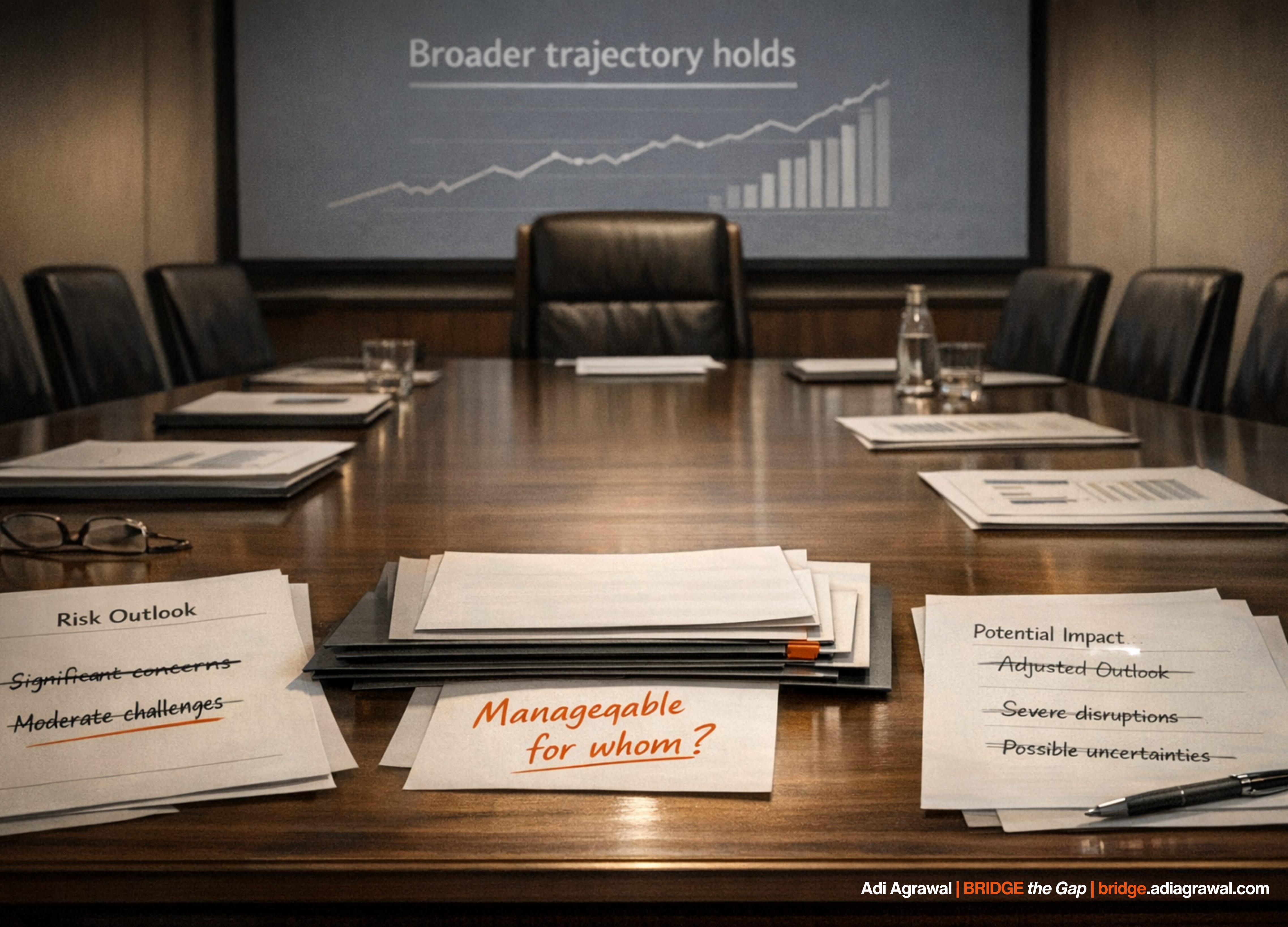
A regional lead had just finished describing a delay in one of Delmar’s cross-border payments programs as “timing-related but manageable,” which was accurate in the narrowest possible sense and meaningless in every other one, when I asked, “Manageable for whom?”
It was not a hostile question. I was not trying to corner him. But it had the effect those questions sometimes have in a room full of senior people who have already agreed, without saying so, what kind of conversation they want to have. A few eyes went down. Someone reached for coffee. Another executive began typing, though I doubt she was taking notes.
Chris looked at me, then at the slide, then back at me.
“I think the point,” he said, calm as ever, “is that we remain within the broader plan.”
It was an elegant answer. It was also the end of the discussion. The regional lead nodded. The next slide came up. A few people nodded their heads, and others made small affirming sounds. The meeting continued as if the question had been fully addressed.
I wrote one line in the margin of my packet and let the next twenty minutes pass.
That was how it happened at Delmar.
Not through some loud cultural rupture. Not through a restructuring memo or a speech about transformation or a dramatic clash that everyone could point to later and say, “That was the moment”.
Delmar was too old, too disciplined, and too successful for that kind of amateurism. It was a global fintech giant built over decades through scale, patience, regulatory fluency, and the kind of operational control that made smaller competitors talk about it as if it were a permanent feature of the global business landscape. Inside the company, people liked to call that discipline. Outside, depending on whether they were trying to buy us, beat us, or admire us from a safe distance, they used different words.
Chris had arrived in the CEO seat without any spectacle. The prior CEO resigned to “spend time with family,” and Chris, who had risen through legal and operations, was in the right rooms and board committee conversations when that happened.
At his first town hall, he said, “Nothing changes. We’re just getting back to discipline.”
Beautiful line. Investors liked it because it promised order. The board liked it because it implied control. Executives liked it because it sounded like protection. Middle management liked it because it suggested they would not have to relearn the company.
I remember sitting there and thinking that whenever a leader says nothing changes, the useful question is not whether he means it. It is what he is preparing to change without having to call it change.
At first, the shifts were mostly in tone.
Chris had a habit of opening leadership meetings with short reflections that did not seem strategic enough to be strategic. He would talk about the people who had built Delmar, the instincts that had carried the company through volatility, the value of alignment at scale, and the need for judgment during noisy periods. Nothing he said was unreasonable. In fact, most of it was true. That was part of what made it effective. He was not trying to convince people of something outrageous. He was slowly building a shared idea of what belonged.
Not formally. Never explicitly.
He had a gift for turning a preference into a principle. Alignment. Maturity. Discipline. Institutional Judgment. He used those words so steadily and smoothly that resisting them made you sound less like a thoughtful dissenter and more like someone needlessly attached to complication.
I saw the language move into hiring before I saw it move anywhere else.
There was no change to the interview framework. No memo to human resources. No rewritten competency model. But in debriefs, a phrase began surfacing with unusual frequency.
Feels like Delmar.
At first, it sounded harmless, one of those lazy but familiar expressions companies use when they are collapsing a hundred impressions into four words. But shorthand tends to have its most consequential impact when nobody bothers to inspect it. Candidates who mirrored the existing executives’ style, who spoke with the right level of control, who carried themselves in ways the company already recognized as credible, moved through more easily. Candidates who brought in thoughtful questions and healthy friction, in experience, in tone, in the way they reasoned, in the kinds of questions they asked, suddenly required more explanation and personal validation.
During one debrief, after a particularly strong candidate had been set aside in favor of someone safer and less capable, I asked, “Are we selecting for capability or for comfort?”
The CHRO answered quickly. “Comfort is a proxy for alignment.”
That sentence hung in the room. Chris did not say anything immediately. He gave a small nod, almost as if he appreciated the efficiency of the phrasing. Then the conversation moved on to succession timing and compensation bands, and the candidate was gone.
That was another feature of the new system. Things moved on quickly once the right words had been spoken.
Meetings changed the same way. Not structurally. Behaviorally.
They became more efficient. Less thoughtful. Less nuanced. Less layered. Discussions closed faster. Fewer threads remained open at the end. If you looked only at the surface, you might have called that efficient. Chris certainly did. He had a way of guiding the room without appearing to direct it. He rarely interrupted. He did not bully. When disagreement surfaced, he would acknowledge it, absorb it, and then narrow its range without seeming to do so.
“Let’s not overcomplicate this.”
“Stay with the stretegy,”
“The broader trajectory still holds.”
Each sentence was balanced, rational, and perfectly defensible. That was the brilliance of it. He was not crushing dissent. He was shortening its life just enough for everyone to understand what kind of disagreement was welcome and what kind would simply be absorbed and neutralized.
People learned quickly.
In a healthy culture, people bring the rough and messy truth into the room and have the confidence and trust to work on it with their colleagues. At Delmar, over time, people started doing the work before they ever entered the room. Concerns were refined in advance. Edges were smoothed. Caveats were buried deep in the materials. Risks were translated into language less likely to sound oppositional. The point was no longer to surface the sharpest version of reality. The point was to present a version of reality that could survive the meeting.
I remember the product review where that became unmistakable to me.
One of our newer offerings, strategically important, still early enough to be corrected, had started showing signs of drift. The metrics were not disastrous. That was the problem. If something is visibly broken, even a defensive company can respond. What is harder is when the numbers are just good enough to appear okay while quietly undermining the reality beneath them. Pricing assumptions were off. Customer behavior was less stable than forecast. Engagement was coming in bursts instead of building in the shape we had forecast and needed.
I laid out the gap plainly. No drama. No attempt to force urgency. I said that if we addressed it now, the correction would be manageable. If we waited, the correction would be harder and more expensive.
Chris listened closely. He asked two sensible questions. Then he said, “Let’s not overcorrect based on early data. The broader trajectory still holds.”
That sentence ended the conversation. A direct disagreement would have created an argument. This did not. It repositioned my concern as technically noted but strategically premature. Nobody pushed further. Nobody wanted to be the person arguing for instability in a room that had become increasingly organized around clean forward motion.
Afterward, I walked out with one of my colleagues. He said, “He didn’t disagree.”
I told him, “No. He closed the door.”
Once you see that pattern, you start seeing it everywhere.
Concerns did not disappear at Delmar. They changed shape. People brought in cleaner versions of what they knew. They learned which kinds of candor extended discussion and which kinds quietly ended it. They learned what gained traction and what made the room uncomfortable.
Nobody had to say, “Don’t push that point too hard” – we learned it by subtle behavior.
By midyear, externally, things looked strong. Revenue steady. Margins improving. Costs disciplined. Analysts heard what they wanted to hear. The board heard what it had hoped for. There is no more protective cover for a narrowing culture than decent numbers and a calm management script.
Internally, the effects were subtle enough to escape formal notice and clear enough to be felt by anyone paying attention. Ideas that required real debate slowed down. Decisions were made faster but came back more often because the harder stuff had not actually been worked through. Attrition rose in pockets, not enough to trigger an alarm, just enough to tell you something about where the company was losing capability.
I raised the issue once in a strategy session after watching three separate risks get translated into “execution details.”
“We’re optimizing for presentation,” I said, “not accuracy.”
Chris looked at me evenly. “I’d say we’re optimizing for clarity.”
Most people would have let that stand. I didn’t.
“Clarity without tension and analysis,” I said, “is incomplete and maybe misleading.”
There was a pause. Not an explosive one. No one lost composure. But it was long enough to reveal that the room no longer knew what to do with an unresolved statement unless Chris resolved it for them. He let the silence sit for a beat, then moved to the next item.
It was handled gracefully. That was the point. At Delmar, the most consequential things were usually handled gracefully.
By then, I knew the shift was complete, even if the company did not. Acceptance still existed, but it no longer meant what it once had. It no longer meant a leadership team strong enough to withstand disagreement and do the hard work with trust and respect.
It meant alignment without resistance. You could still challenge something, in theory. The conversation would be short. Your point would be translated into something less disruptive. You would begin, gradually, to sound like someone attached to complexity while others sounded constructive.
That is how dissent becomes useless. Not forbidden.
Just personally expensive.
When I decided to leave, nothing dramatic happened. No confrontation. No final showdown. No speech worth remembering. My exit was processed with professionalism, as these things always are in well-managed institutions. Chris thanked me graciously. The announcement said the right things. People wrote kind notes. The machinery of continuity did its work.
On one of my last days, someone asked me whether it had been worth staying as long as I had.
I told him the truth.
“That depends on what you value.”
He asked, “And you?”
I said, “I value being in rooms where the truth is welcome, and we can work on hard things with mutual respect and trust.”
After I left, I heard that meetings got smoother.
That did not surprise me. Smoothness is often what organizations get in exchange for innovation and growth. Alignment comes faster when people know, in advance, which thoughts are worth bringing into the room and which ones should be handled privately, softened, or dropped altogether. On paper, the system still worked. In fact, on paper, it may have looked better than before - but only in the immediate.
What changed at Delmar did not happen through policy. It happened through tone, repetition, timing, and the steady education of response. A phrase in a hiring debrief. A reframing in a product review. A calm sentence that made a difficult issue sound slightly immature. Small signals, individually defensible, collectively decisive.
I still think about that first question in the operating review.
Manageable for whom?
It was not a grand challenge. It was barely even dissent. It was just an attempt to be truthful and seek honest clarity.
It didn’t survive very long.
After a while, neither did much else.
I welcome your feedback on the story.
Enjoy your loved ones and the rest of your day. And thank you for spending some of your day with me.
Warm regards,
Adi
♻️ If you liked this - Restack this!
➕ Follow Adi Agrawal on LinkedIn
Conformance always comes with a price tag. Smoothness was never my native language. The story gave sense to my experience.
well written!