

Headcount Is Not Scale
A Founder’s Lesson in the Difference Between Growth and Leverage

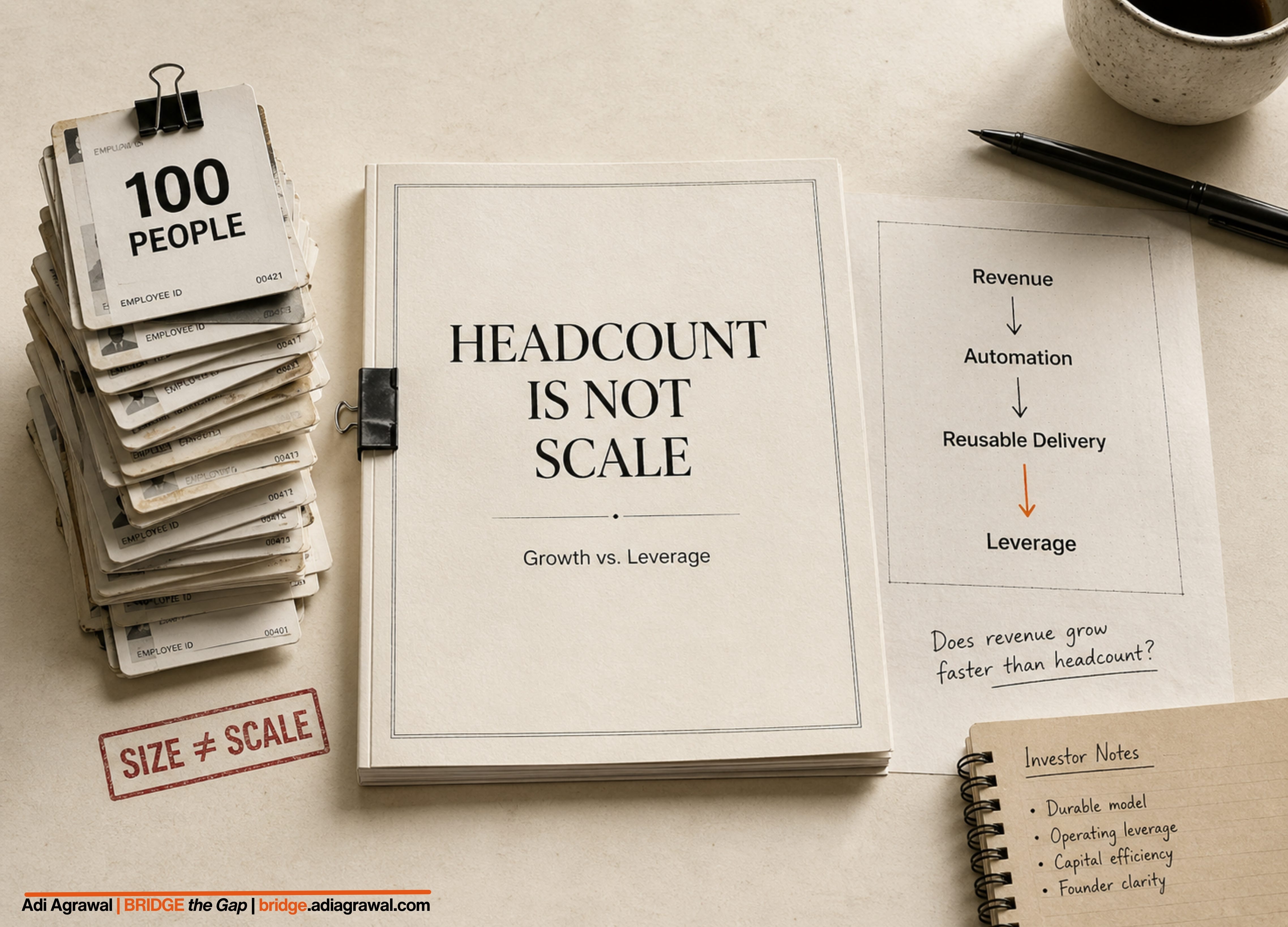
This is a composite story based on real advisory work I have done. Company, founder, and identifying details have been changed…
The Pitch
Gurgaon — October 21, 2025
The late afternoon sun was striking the glass towers of Cyber City, giving the whole district the look of speed and importance. From the road below, Gurgaon can make almost any business look larger than it is. The gleaming towers suggest capital, momentum, and modern ambition. Inside Rahul’s office, the feeling was smaller and more human.
The room was cramped. The desks outside were pressed close together. A few chairs made a tired sound every time someone shifted.
Rahul sat across from me with a pitch deck in his hand.
He had built this company from nothing. You could see it in the way he held the deck. It was not just a set of slides. It was his proof. Proof that he had won clients, hired people, made payroll, survived late payments, and kept the business alive through months when their bank balance fell into warning territory.
“I don’t get it,” he said. “We have one hundred people. Eighty are billable. Twenty are leadership and support, and we recover that through overhead added to the billing. We did $2.75 million last year. I’m asking for a $10 million valuation. That’s fair for what I’ve built?”
He looked at me and waited, still holding the deck as if the answer was somewhere inside it. I looked again at the revenue number. A hundred people. $2.75 million. Even before doing the math, the shape of the problem was visible. The business had grown, but it had grown by adding people.
“Rahul,” I said, “when an investor looks at your company, what do you think they are buying?”
He answered quickly. “Growth.”
“What kind of growth?”
He looked irritated now, because the question sounded too simple to be useful. “Revenue growth. Client growth. Team growth. We have added people, added accounts, and the pipeline is strong.”
“That may all be true,” I said. “But if every new dollar of revenue needs more people, more managers, more hiring, more payroll, and more pressure on you personally, then the investor has to ask a different question. Is this company scaling, or is it becoming heavy?”
Rahul frowned. Not because he disagreed. He frowned because he understood, before he wanted to admit it, that we were no longer discussing the pitch he had prepared. We were discussing the business he had built.
“I have scale,” he said.
“You have size,” I said. “That is not the same thing.”
For a few seconds, neither of us spoke. Outside the glass wall, one engineer leaned back from his screen and rubbed his eyes. Another was trying to keep his voice calm on a client call. Rahul glanced toward them, and I could see the conflict move across his face. These were his people. They were also his proof. He had spent years turning empty desks into occupied ones, and now I was telling him that the desks themselves might not persuade anyone who understood the economics of the company.
“That sounds harsh,” he said.
“It is harsh,” I said. “But it is not an insult. It is the difference between a company that grows stronger as it grows and a company that just – grows.”
He looked down at the first slide again. The chart moved upward. But the company underneath the chart was tired. Revenue had grown. Headcount had grown. All in lock step. The problem was obvious.
“The problem,” I said, “is that your story is built around headcount. Investors will not pay a premium for headcount unless they can see operating leverage behind it.”
He nodded slowly, but not in agreement yet. More like a man allowing an uncomfortable thought to be considered.
The Raise
O’Hare — November 13, 2025
Three weeks later, we met near O’Hare after Rahul had flown in for a client meeting. He had just finished a tense call with one of his senior developers in India, a young man who had been with him through several difficult projects and now wanted a market-level salary. Not an extravagant salary. Not founder-money. Just enough to make staying feel less foolish.
Rahul was pacing when I walked in.
“If I pay him what he wants, the margin on that project vanishes,” he said. “He’s good, but everyone is replaceable. I can find two juniors for the same cost.”
I waited before answering. Some sentences reveal a business more clearly than a spreadsheet.
“Do you believe that?” I asked.
“Believe what?”
“That two juniors can replace one person who understands your clients, your code, your delivery history, your past mistakes, and all the things your process documents pretend to capture but don’t.”
He looked away.
“That’s not the point,” he said. “The math does not work.”
“The math does not work because the model does not work.”
That annoyed him more than the first conversation we’d had. He was used to discussing pricing, utilization, and margins. Those were safe and logical arguments. They kept all his problems within his spreadsheets. This was different.
“You are treating him as expensive because his value is trapped inside billable hours,” I said. “If all he does is work on one client project, then yes, his salary squeezes that project. But if he builds something that improves delivery across fifty projects, he becomes one of the cheapest people in the company.”
Rahul sat down.
I showed him the comparison, not because Nvidia was a fair peer for his business, but because the contrast made the point impossible to avoid.
Rahul’s company had done $2.75 million in revenue with 100 people. That meant revenue per employee was about $27,500.
Nvidia had reported more than $60 billion in fiscal 2024 revenue with fewer than 30,000 employees, which meant revenue per employee was a little over $2 million.
Cognizant, a large services company, was a more relevant comparison. It had reported about $21 billion in 2025 revenue with roughly 351,600 employees, or about $60,000 in revenue per employee.
Rahul stared at the numbers for a while.
“I am not Nvidia,” he said.
“No one expects you to be Nvidia,” I said. “But you are not even close to Cognizant yet. And Cognizant has global delivery systems, client depth, management infrastructure, recruiting scale, and decades of operating discipline. You are asking investors to believe in scale, but your economics don’t show it.”
He rubbed his face with both hands, and for the first time, I saw the fatigue behind his confidence. Founders like Rahul often look stubborn when they are really scared. Payroll teaches them fear. Client concentration teaches them fear. A missed invoice teaches them fear.
“I thought I was protecting the business,” he said.
“You were protecting every month’s margin,” I said. “That is different from growing a strengthening business.”
He did not answer. He just sat there in silence.
The Lost Deal
Dubai — January 14, 2026
By January, the market made the point more sharply than I ever could.
We were in Dubai Internet City, in a small borrowed office on the edge of the district. Rahul had just lost a contract to a similarly sized firm from Singapore. His team had proposed twenty people and a detailed delivery process. The Singapore firm had proposed five people and an AI-enabled delivery suite with tons of innovation and options.
“They undercut me by twenty percent,” he said.
He was angry, but beneath the anger was something more useful. His fear finally had a specific reason.
“How am I supposed to compete with that?”
“By changing what you sell,” I said.
“I sell time and delivery.”
“That is the problem.”
He looked at me as if I had dismissed the entire company in four words.
I asked him what the client had actually bought from the Singapore firm.
“Unproven AI and promises,” he said.
“No,” I said. “They bought lower risk, faster delivery, fewer handoffs, and less management effort. AI-enabled tooling was one of their labels. But the real leverage was product optionality and speed.”
He turned toward the window. Dubai looked calm from up here, which is one of Dubai’s tricks. It can make even unfinished things look intentional.
“You keep selling people,” I said. “They are selling a system.”
He hated that sentence. I could see it in his face. It sounded unfair because his people were good. They worked late. They solved problems. They cared more than many employees in companies twice the size. But that was also why the sentence hurt. His best people were being used to repeat work that should have been turned into tools, automated checks, templates, reusable code, decision rules, and training systems.
“You are making talented people behave like inventory,” I said.
Rahul was quiet for a long time. “I thought being frugal made me disciplined,” he said.
“Sometimes it did,” I said. “But sometimes it made you cheap in the wrong ways.”
He gave a small laugh. “That sounds like something my wife would say.”
“She may be right.”
It was the only light moment we had that day.
Then his face changed.
“I almost lost that developer,” he said. “And if he leaves, I will tell myself he was disloyal.”
“Would that be true?”
He looked down.
“Or would it be easier than admitting he got tired of being treated like a cost?”
That was the hardest moment. Not the lost contract. Not the Singapore competitor. Not the numbers. It was the realization that the problem was not just operational. He had asked people to care like owners while managing them like replaceable inputs.
Many founders do this without meaning harm. They confuse loyalty with endurance. They mistake silence for commitment. They tell themselves that people understand the sacrifice because the company is still young, still fragile, still fighting. Then one day, a good person leaves, and the founder calls it betrayal because the alternative is harder to face.
Rahul did not defend himself this time.
He just said, “I need to fix this.”
The New Deck
Gurgaon — March 23, 2026
By March, we were back in Gurgaon.
The office looked no better in the months since my first visit. The desks were still crowded. The chairs still complained. But the room felt different because Rahul had changed.
A whiteboard near his office was covered with diagrams for a highly automated design, engineering, delivery, and testing platform. This was not client work. It was internal work, the kind founders often postpone because it does not create an immediate billable invoice. For Rahul, that had always been the excuse. There was always another client demand, another delivery problem, another cash concern, another reason to ask good people to repeat work instead of giving them time to improve and innovate.
This time, he had stopped.
He had canceled the plan to hire twenty more people in the first quarter. Instead, he gathered his five strongest developers, including the one who had asked for the raise, and told them the truth. The business could not keep growing by adding bodies. He had treated senior people as replaceable. If they could automate the core delivery process, he would share part of the savings through bonuses and profit-linked compensation.
“How did they react?” I asked.
“At first, they did not believe me,” he said.
“Why?”
“Because I have trained them not to.”
It was the most honest thing he had said in six months. Rahul had not built a bad company. He had built a company around fear, then called the fear discipline.
The early results were modest but real. The company did $800,000 in quarterly revenue with the same hundred people. Revenue per employee moved from roughly $27,500 toward $32,000. Nobody should confuse that with a transformation. But in founder-led companies, the first useful signal is often not the number itself. It is the change in behavior that produces the number.
Earlier, when a new project came in, the first question was who could be staffed on it. Now the team was asking why the project needed so many people in the first place. Earlier, Rahul had asked whether he could hire cheaper. Now he was asking whether the work could be made repeatable. Earlier, every raise felt like a threat to margin. Now, the best people were beginning to look like the only path out of the low-margin trap.
“And the investors?” I asked.
He opened his new deck.
The first slide no longer bragged about headcount. It did not try to make one hundred people sound like scale. It showed a simple operating thesis: revenue growth had to separate from headcount growth. Under that was a small chart showing where automation had already reduced delivery effort, where billing accuracy had improved, and where senior engineers were replacing manual review with reusable tools.
“This is better,” I said.
Rahul looked relieved, but not triumphant. He knew the company was still fragile. He knew one good quarter did not prove anything. He also knew, perhaps for the first time, that the old pitch had asked investors to reward the wrong thing.
“I kept telling them we had a hundred people,” he said. “As if that was the proof.”
“It was proof of effort,” I said. “Not proof of leverage.”
He looked through the glass wall at the team outside. The same people were working at the same crowded desks. But he was no longer looking at them as payroll. He was no longer using them as cogs in a scale story. He was beginning to see them as the only people who could help the business become less dependent on constant hiring, constant pressure, and constant founder heroics.
“I told the investors we are not trying to become a thousand-person service firm,” he said. “We are trying to deliver the most with the least using innovation.”
That was a clean strategy.
The office was still imperfect. The business was still early. The valuation was still uncertain. But Rahul had stopped trying to raise money on the weight of what he had built. He was starting to show how value could be reengineered.
And that is a different conversation with investors.
It is also a different conversation with yourself.
Enjoy your loved ones and the rest of your day. And thank you for spending some of your day with me.
Warm regards,
Adi
♻️ If you liked this story - Restack it!
➕ Follow Adi Agrawal on LinkedIn