

Gratitude for the Commonwealth
Much of my life was made possible by people I'll never meet

This morning I woke in a warm house, turned a tap, and drank water that would not hurt me. I pressed a switch, and the light came on. I boiled water for tea on a flame I never had to gather wood for. I did all of it half-asleep, already rehearsing my day, taking none of it in.
It has taken me most of my life to notice that almost nothing is mine alone. The water is made safe by people I will never meet. The electricity I use crosses a grid that strangers drew, financed, and kept alive through nights I slept through. The roads outside my home were graded and paved long before I needed them. I have the privilege of waking in a world already warm because of other people’s work — most of them strangers, many of them long gone, none of them waiting to be thanked.
For the longest time, subconsciously, I kept a sort of ledger of things I had earned. The degree. The work. The hard seasons and what they bought. I was not ashamed of that ledger; I showed up for every line of it. But at some point, I began to see the second hand resting on each entry — a teacher who stayed late out of nothing but kindness, a clerk who stamped a form, a stranger on a hiring committee who read an unfamiliar name and decided to take a chance.
No one wakes up self-made. We wake up in a commonwealth.
• • •
I think about this more than I used to. I can point to the exact people and opportunities that got me here.
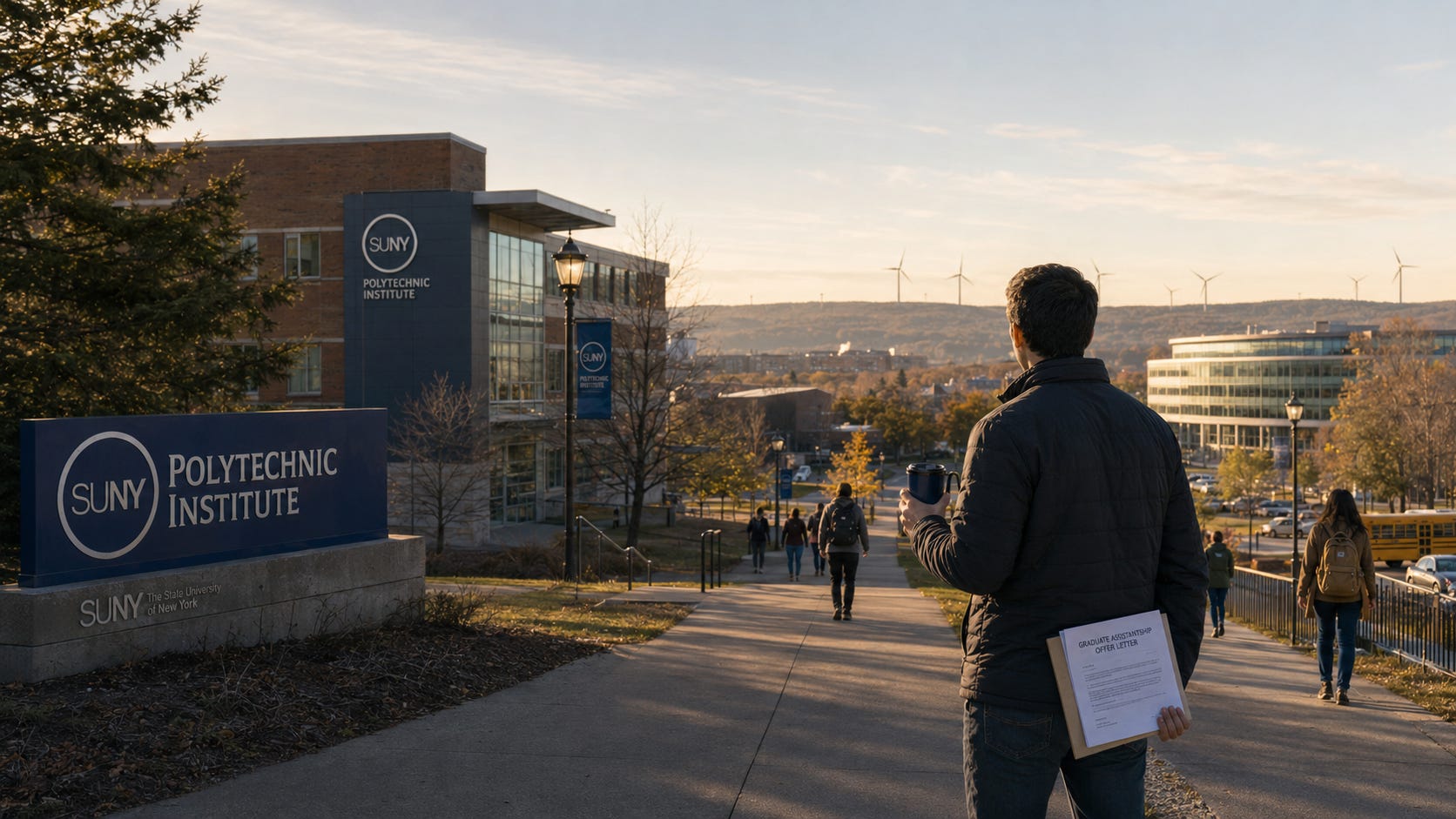
I came to this country as a financially struggling kid from India to study computer science. I earned my master’s at SUNY Polytechnic — a public university paid for by the citizens of the great state of New York, people who never know me. They funded a scholarship for a kid from halfway around the world. A teaching assistantship and a research assistantship. The patient hours of faculty, and behind them, a whole state system built over generations, so that a kid like me could find an on-ramp.
I did the studying. But the road I studied on was laid by other people’s generosity and handed, without constraint, to a stranger from another continent. I cannot return that generational gift to the people who paid for it. They are not collecting. It is a debt I can only carry forward.
• • •
Here is what I used to forget, in many moments, nearly every day.
I would pick up my phone and feel like I was holding a piece of pure private genius. But the internet access inside it began as a government research project. Its maps rode on satellites the public launched. The screen I tap and the assistant I speak to both started in publicly funded labs — including the one I worked in during grad school at SUNY. The real object I own is, underneath it all, a public inheritance.
This is not about gadgets. The great state universities were built by citizens. The uber exclusive famous private ones are not as private as their crests suggest: close to sixty percent of their research money comes from federal taxpayers, on top of the tax breaks and student aid the rest of us cover. No diploma in this country is entirely self-funded. Somebody I will never meet helped pay for mine, and for yours.
And under all of it sits the quietest gift — the rule of law. A contract honored — disagreements settled in courtrooms instead of in the street. Every ambition I have ever had was built on a foundation, and I did not lay any of it.
• • •
I have caught myself sliding the other way too — the small, ungrateful arithmetic that says I built this alone, so the slice is mine, so why should I be asked for any of it back. The more a system carries you, the easier it becomes to forget you were ever carried.
And in the country that accepted me as a citizen and that I have called home for more than three and one-half decades, that arithmetic has a cost you can see from the sidewalk. The United States is the richest nation in human history, and still, on a single block, you can find staggering wealth beside someone who cannot afford the medicine that would keep them well, the rent that would keep them housed, the food to carry their children to the end of the month.
That distance is not an abstraction here. It is visible, daily, up close.
What surprised me, coming from where I came from, was not the poverty. I had seen poverty. It was that in the wealthiest country on earth, the floor itself is still up for argument. In much of the developed world, a few things are simply settled: that a person should be able to see a doctor without being ruined, that a child should be schooled, whatever the parents earn, that no one should go hungry in a land of plenty, that the commonwealth should be funded and tended as a matter of course.
These are not favors a nation does for its fellow citizens. It’s not even our politics — these are the default a developed nation provides and stops re-litigating. I wonder why this baseline is contested, and the question of what each of us owes the whole is reopened every season, as if new.
Nobody enjoys being asked to pay. I don’t either. But everybody needs somebody to pay for the roads, the schools, the grid, the lab, the clinics, the courts. The fair argument is the one about how we share that obligation — what each citizen’s equitable contribution ought to be. That the bill exists at all, and that it bought the life I am living, is not really in question. The only real question is who keeps the whole thing standing — and whether those of us it carried the farthest will help carry it in turn.
• • •
This is a thank-you, and a quiet promise.
Gratitude has not made me prouder or smaller about my own work. It has only made me honest about it. To say “I worked hard, and a thousand strangers made the work possible” is not modesty. It is the truth.
It asks me to hold the door instead of letting it swing shut. To believe the pie of opportunity grows continuously, as it did for me. To pay forward what I can never pay back — the scholarship, the chance, the patient hour given to someone who has not earned it yet, the way it was once given to me.
I cannot repay the citizens of New York who educated a stranger. They are not collecting. What I can do is live as though I owe, and spend the rest of my life holding open doors for those who are seeking an on-ramp to their lives and dreams.
To everyone who built the road before I arrived, and to everyone still paying for it: thank you. I see it now. And I mean to be worthy of it.
• • •
Thank you for reading and spending some of your day with me.
Please do take a moment to share your thoughts, comments, likes, and questions.
— Adi