


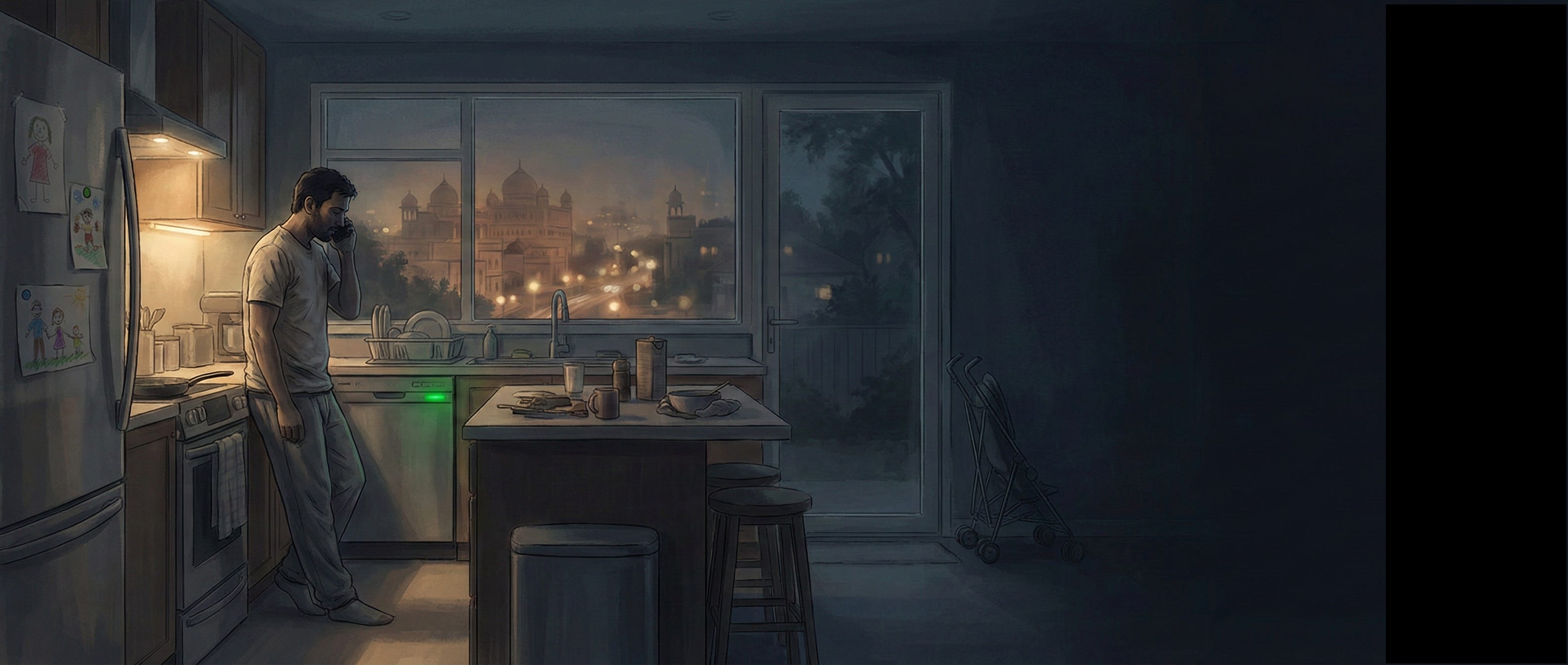
The line didn’t crackle. It didn’t drop. It just went quiet in that very specific way my father has when life gets bigger than his words.
I was 35, standing barefoot in the kitchen of our house in the Chicago suburbs. The dishwasher was humming. My daughter’s toys were scattered in a loose minefield across the floor. My wife was upstairs, exhausted, pregnant with our second child, and already halfway to sleep.
On the other end of the call, in a small apartment in India, my father was processing the sentence I had just spoken.
“Papa… we’re moving back to India. I’ve accepted a new role there.”
He had watched me leave a dozen years earlier with two suitcases and a graduate school admission letter. He had watched from a distance as those years in America slowly became a life: degree, first job, better job, the house, his first grandchild, the green lawn, and the uncomfortable comfort of property taxes.
He was proud. He would tell his friends where I worked, what I did, and how we were “settled.” But underneath the pride, there had always been a thin thread of worry, the kind a parent never really lets go: Will this last? Will they be safe? Will this all collapse and leave him with nothing?
Now I was telling him I wanted to walk away from that stability and start again in the country I had once left.
“You already have everything there,” he said finally. His voice was calm, but tighter than usual. “Good job. Good house. Good future for the children. Why do you want to disturb all this now?”
That word. Disturb.
Not grow. Not change. Disturb.
Behind it, I could hear a whole chorus of unspoken fears:
What if the growth doesn’t last? What if the company there is not as solid as this one? What if you fail and regret it, and I have to watch that from here?
He didn’t say any of that. He didn’t have to. I knew his worry well enough to fill in the gaps.
I tried to explain. The opportunity. The scope. The chance to try something new and meaningful in India. The way it lit me up in a way my current, very good life had stopped.
He listened. There were long pauses.
“In the end, you will decide,” he said. “You are there. You see what I cannot see.”
And then, softer:
“I just don’t want you to make a mistake you cannot undo.”
We said good night. We said I love you. We hung up.
And then I stood alone in that dark kitchen, the hum of the dishwasher suddenly very loud, staring at the outline of my own “good life” — the fridge with my daughter’s schedule taped to it, the bills on the counter, the stroller by the door — and felt a wave of shame.
Not because I wanted to run away from my responsibilities.
But because wanting more from my life suddenly felt like betraying the man who had spent his entire life trying to make sure I had enough.
Curiosity is easy to celebrate when it stays safely in the realm of hobbies and ideas.
Be curious about books. Be curious about technology. Be curious about history. That kind of curiosity doesn’t threaten anything. It fits comfortably inside the life you already have.
But there’s another kind.
The curiosity that looks at your own life – the carefully built, very respectable and predictable one – and whispers, “Is this it? Is this the only version of you the world will ever get to meet?”
The curiosity that hears about a role in another country and doesn’t just think, Interesting, but feels a pull in the chest and a thought you’re almost afraid to complete: What if I actually went?
That kind of curiosity doesn’t sit politely in a corner. It walks straight into your relationships, your culture, your career, and starts moving furniture.
It was easy for me, in my twenties, to dress curiosity up as ambition. Take the harder project. Enroll in the MS program halfway around the globe. Work my butt off. And then go get that top school MBA. Go for the bigger roles. Everyone applauds those moves.
What I felt now was different. This wasn’t about climbing. It was about crossing: from one country back to another, from one story of stability to another story I couldn’t yet fully see.
And that’s where curiosity started to feel like disloyalty. Disloyalty to my family, who worry that we’re about to break something precious. Disloyalty to my company, which trusted me and invested in me. Disloyalty, in some twisted way, to my younger self, who fought so hard to get here and now watches me volunteer to step into uncertainty again.
And disloyalty to my wife, who trusts me unquestioningly - my baby girl and my unborn son.
My father is not a man of many speeches. He didn’t come to America. I did. His world was built in India: long hours, modest means, a life measured in tuition payments and exam results, and the quiet satisfaction of seeing his children in places he never imagined for himself.
In his mind, my life in the US was a miracle you did not play with.
He would never have used those exact words, but I knew that’s how it looked from his balcony in India: his son, with American graduate degrees, a respected role, a house in a safe suburb, a grandchild with an American passport, and a backyard. It was all slightly unreal and therefore slightly fragile.
So when I told him we were choosing to step away from that and into something unproven, it wasn’t that he didn’t trust me. It was that he did not trust the world.
He had lived long enough to see how quickly things could turn, how easily stability could evaporate. His fear was not that I was ungrateful. He feared that I was naive. That I would chase a feeling, ignore the risk, and one day call him, saying, “You were right. I made a mistake I can’t fix.”
From his vantage point, my curiosity looked reckless.
From mine, his fear looked like a weight on my chest.
Both were, in their own way, acts of love.
The months that followed that call were not cinematic.
They were spreadsheets and late-night talks with my wife. There were questions about schools and healthcare, and our starting to age parents. They were moments of absolute conviction followed, on some days, by sudden panic: What are we doing?
Some nights, I would lie awake and see two possible futures in front of me.
In one, we stayed. We kept the house, the job, the routines. Both sets of our parents slept better. The story made sense to everyone. I would have been, by any reasonable standard, successful. I could also feel, in that imagined future, a part of me gradually dimming — the part that wanted to build something different, in a place that shaped me, with the tools I’d spent years collecting.
In the other future, we left. We moved back. It was harder. Messier. The career path looked less like a straight line and more like a sketch. My father worried more. I worried more. But there was also a sense of alignment — of life lived with both feet in, not one foot in and one foot on the brake.
It took me a while to realize that staying only to avoid his disappointment would not actually protect him from pain. It would just trade one kind of fear — fear of failure — for another kind of regret.
I began to see that there are at least two kinds of disloyalty.
One is obvious: abandoning your responsibilities, breaking trust, walking away from people who depended on you because you’re bored.
The other is quieter: abandoning your own life to keep other people comfortable, and then secretly blaming them when your soul starts to complain.
We made the move.
There were days in those first months in India when I thought, He was right; I’ve lost my mind. The heat, the traffic that moved like a living organism, the bureaucracy that treated urgency as a suggestion, the way a simple errand with two small children could swallow half a day — all of it mocked my carefully optimized American routines.
And yet, there were other days when it felt like my whole life had been walking toward this.
Sitting in a cramped conference room with a team that was in their 20s, building something from the ground up in a market that felt electric. Hearing Hindi and English and three other languages bounce around the table. Realizing that the problems we were solving actually mattered to people who looked like my family, not just to an abstract “market segment” on a slide.
Watching my daughter run barefoot on a terrace and playing with cousins, she would never have known if we hadn’t come. Watching my parents eat dinner with their granddaughter on an ordinary weeknight instead of on a video call squeezed between time zones. They were the kind of moments you remember when you are old and trying to answer the question, What did we do with our time?
Professionally, it was the most intense year of my life.
Every day presented a new kind of test: political, cultural, financial, emotional. I had to unlearn shortcuts I’d developed in Western corporate life and relearn how power, trust, and time worked here. It was exhausting and humbling and, in retrospect, the single greatest learning year of my career. India has a way of stripping away the illusion that you are in control and replacing it with a very direct question: Can you still build, even when nothing behaves the way you prefer?
And then, just when we had begun to find our footing, the floor moved.
The business shifted. The numbers turned. The story changed in rooms I wasn’t sitting in. One day, there was a role. A few conversations later, there wasn’t.
I was laid off. In the very country I had confidently brought my family back to. In the very chapter, my father had feared would end badly.
I remember walking out of that meeting into the November chill of New Delhi, the city noise pressing in from all sides, and feeling two things at once.
One was a sharp, familiar panic: What have I done? I dragged everyone here, and now I’ve proven him right. I could already imagine the questions, the quiet I-told-you-so living under the surface of every kind word.
The other, surprisingly, was clarity: I would still have come.
Losing the role hurt. It bruised my ego, stressed our finances, and forced decisions we weren’t ready to make. We did what we needed to do – tightened, talked, recalculated.
Every time I fu**-up, I end up asking my wife, friend, and biggest cheerleader, “Will we be okay?” and without fail she will say, “Of course - we are together”.
And eventually, yes, we came back to the US, not as a triumphant “return,” but as a family carrying one more complicated chapter in our story.
From the outside, it might have looked like failure: we went, we struggled, we got knocked off the ladder, we returned.
From the inside, it felt different.
I had seen what it meant to build in a place that held my childhood and my contradictions. I had watched my children form memories with grandparents that no phone call could have manufactured. I had been humbled, stretched, and forced to confront parts of myself that might have stayed comfortably asleep in the suburbs.
If the move had been a product, the P&L would have been messy. As a life, it was irreplaceable.
Somewhere in that year, between the intensity of the work, the chaos of the city, the ordinary joy of those family dinners, and the quiet humiliation of losing a job I had uprooted my life for, my relationship with curiosity changed.
I stopped treating it as a guilty itch I had to explain away to everyone who loved me. I started to see it as a form of stewardship. If life hands you the chance to grow, to see more, to become more useful and more alive, maybe the risk is not in going – maybe the greater risk is in refusing.
I also began to understand my father differently. When I told him about the layoff, there was that same long silence. Then he asked the one question I didn’t expect:
“Are you okay?”
Not I told you so. Not Why did you do this? Just that.
In that moment, I saw his earlier warnings in a different light. He hadn’t been trying to chain me to America. He had been trying to shield me from this exact pain – the shame of feeling like you gambled and lost. His worry wasn’t an accusation. It was a love story written in worst-case scenarios.
Once I understood that, I could do something I hadn’t known how to do before:
I could honor his fear without obeying it, and I could honor my own curiosity without pretending it had “worked out” neatly to justify itself.
I had gone. I had learned more in one year than in the five before it. I had been knocked down. I had gotten back up. And I had no regret.
Enjoy your loved ones and the rest of your Sunday!
And thank you for spending some of it with me.
Warm regards,
Adi