

Bias for Moments
Memories and experiences need to be created with intention

The math of eighty-five and eighty is rich.
These are not just numbers; they are sacred milestones for our family. They represent sixteen decades of survival, sacrifice, and the quiet building of a family. For months, our calendar had been anchored to this single week. The gathering of the tribe. Our three young adult children were scheduled to descend into New Delhi to light the candles for their grandparents. It was the kind of plan that felt solid, inevitable, and essential.
Then, the world shifted.
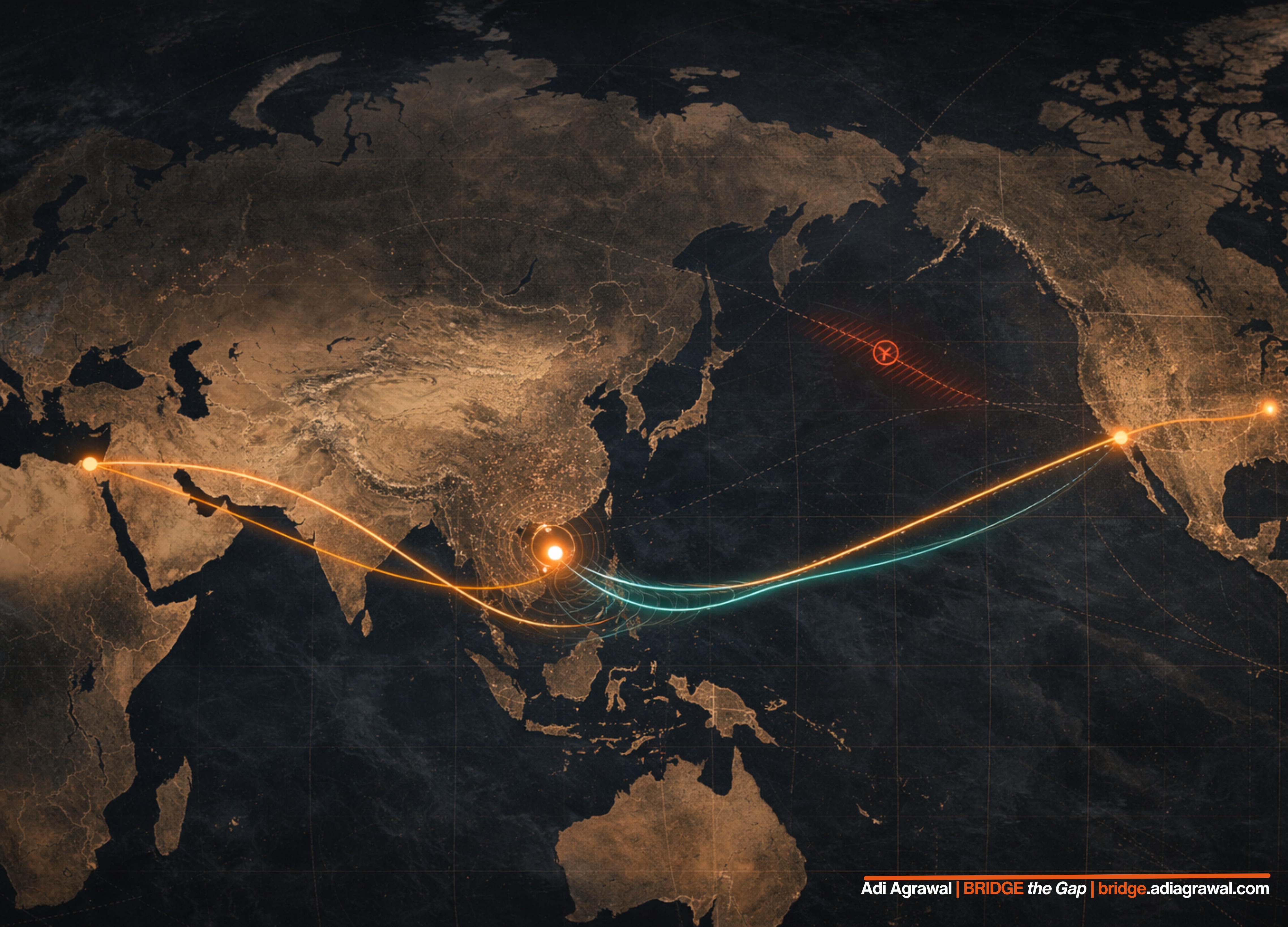
Conflict erupted in the Middle East. Overnight, flight paths that bridge the West to India – trajectories usually traced in efficient air routes – suddenly looked like jagged scars on a map. Disruption rippled through the global nervous system. For us, it meant the routes my children were booked on were suddenly swerving through zones of high tension.
As a builder and a strategist, my first instinct was to deconstruct the risk. I looked at the logistics. The airlines, digging into their own rigid protocols, refused to offer refunds, cancellations or new routes – they were frozen. The flights were technically “scheduled,” even if the world beneath them was on fire. I sat in my sister’s New Delhi living room, looking at the news cycles and the flight trackers, and felt the weight of constraints.
My wife and I sat down and we made the “rational” decision. We called our children.
“The risk is too high,” we told them. “The airlines are being inflexible, the rerouting is messy, and the tension is rising by the hour. We should reschedule. Let’s aim for the end of the year when things are settled.”
The silence on the other end of the line was cold. I could feel the emotion our children were feeling – a promised moment being liquidated by logic. My parents (the grandparents), who had been counting the days, who had been moving with a newfound vitality at the prospect of seeing their grandchildren – took the news with a quiet, dignified disappointment. They are of a generation that understands sacrifice, so they didn’t argue. But the light in the house seemed to dim.
We were hiding behind constraints. We were letting the friction of the world dictate the decisions impacting our family. We were choosing a safe exit over a complicated entry.
But my children – a class act in every sense of the word – refused to accept the math.
There is a specific kind of agency that develops when you stop asking “What are the rules?” and start asking “What is the intent and what are the options?”
Somewhere along the way, we must have done something right as parents, because my kids didn’t retreat into the disappointment. They didn’t wait for the airlines to make it easy for them or for the world to become more convenient. They didn’t accept my “rational” conclusion that the trip was impossible.
Instead, they sprang into action.
They spent the next forty eight hours in an emotional war room of their own making. They mapped out alternate Pacific routes – long, sweeping arcs that avoided the conflict entirely but demanded a staggering physical toll. They traded the comfort of a 14-hour direct flight for a grueling, 40-plus hour odyssey each way. They navigated through time zones and terminals that made no sense, booking new legs, absorbing the costs, and ignoring the sheer exhaustion of the task.
They chose the 40-hour trek over a “safe” cancellation.
Why? Because they understood a truth that I, in my desire to protect them, had temporarily forgotten:
Joy is not a default setting. It is a manufactured outcome. It is something you have to build, often in the face of every reason to stop.
The arrival in Delhi was a somatic experience.
I watched them walk through the door, staggered by jet lag, their eyes bloodshot from two days of recycled airplane air, but radiant with intent. Seeing them wasn’t just a “family reunion.” It was a demonstration of a philosophy. They had made it just in time for the ceremony the next day.
The look on my parents’ faces – the recognition, the realization, and then the sudden, overwhelming flood of life that filled their eyes – was something no “rescheduled” trip in December could ever have replicated. December is a promise; today is a reality.
As I sat in that living room, watching three generations laugh over a meal that almost didn’t happen, I realized that I was the one being coached. I had looked at the global map and seen only the blockades. My children looked at the same map and saw only the destination.
In my professional life, I often talk about a “Bias to Action.” We look for it in founders, and we demand it in our teams. But we rarely talk about the Bias for Moments.
We spend so much time optimizing for risk mitigation and efficiency that we forget that the most valuable things we ever build are actually memories. And those memories are almost always the result of someone deciding to ignore a very reasonable constraint.
The world is increasingly designed to offer us excuses. The airline says no. The insurance says no. The geopolitical situation says no. The “Macro Outlook” will always find a reason for you to stay home, to stay safe, and to wait for a “better time.”
But “better times” are a mirage. There is only the time we have and the intent we bring to it.
When my kids decided to turn a 20-hour journey into a 40-hour marathon, they weren’t just traveling. They were iterating. They were finding their “Pacific Route” around a global blockade. They were refusing to be “managed” by circumstances. They proved that if the intent is strong enough, the constraints become irrelevant.
You earn the trust of the people you love by showing up when it is difficult, not just when it is convenient. You sustain the delight of a family by proving that your presence is more powerful than the world’s friction.
As I watched my eighty-five-year-old father hold his grandsons’ hands as his granddaughter hugged him, I felt a deep sense of pride – not in my own logic, which has often been flawed, but in the people my children had become. They reminded me that while Expertise and Experience often prevail in decisions, Agency is what actually moves the feet.
We all need to ask ourselves: What are we hiding behind right now?
Are we letting a “rational” obstacle kill a moment that can never be recovered? Are we choosing the safety of a cancellation over the messy, exhausting work of creating joy?
Milestones don’t wait for the world to be peaceful. They don’t wait for the logistics to be flexible. They don’t wait for schedules to be clear or for the “Macro Outlook” to be favorable.
You either choose the moment, or you choose the excuse. You cannot have both.
Our children chose the moment. They chose the 40 hours of travel each way within a week’s window. They chose the exhaustion. And in doing so, they gave my parents –and me – a gift that will outlast any strategic plan I’ve ever written.
They taught me that joy isn’t something you find; it’s something you fight for.
Enjoy your loved ones and the rest of your day. Especially the moments that require you to travel the long way around. Those are the only ones that truly count.
And thank you for spending some of your day with me.
Warm regards,
Adi
♻️ If you know that Moments are more important than Constraints - Restack this!
➕ Follow Adi Agrawal on LinkedIn