

Be A Heat Sink
Real Leadership Is Adding Surplus Value

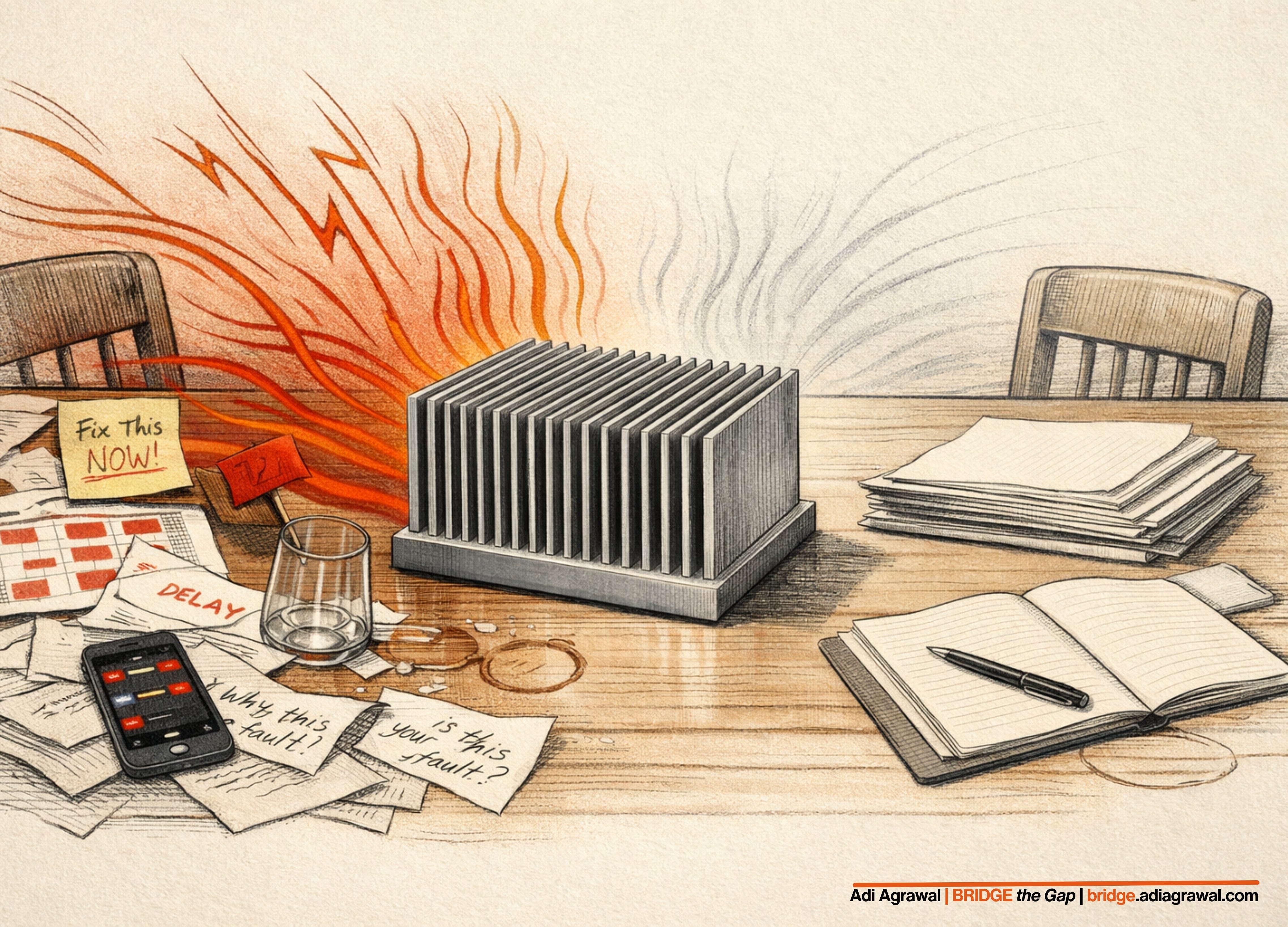
I was in my mid-thirties before I realized that being the most capable man in a room often means being the one who takes the heat without passing it on.
In my early career and family life, I used to think leadership was about the projection of will – about who had the loudest, most articulate voice or the final word. But then I started carefully watching leaders I actually respected, the ones who didn’t need to perform. They were the ones who could sit in the middle of a disaster and act as a buffer. They didn’t deflect or blame; they simply stayed steady so everyone else could breathe.
I clearly remember a project launch that had gone completely sideways. We were in a cramped office, and the Executive VP was pacing, looking for someone to tear into. He was shouting, his face a deep red, and he was focused on one of my leads. The lead was twenty-eight, brilliant, and visibly shaking. She was getting ready to pull up some operating logs and start pointing fingers at vendors just to save herself from the blast.
I could have let it happen. I could have joined in on the critique to protect my own standing.
Instead, I remembered those leaders I admired. I leaned forward and told the VP that the responsibility stayed with me. I didn’t offer an excuse. I just sat there and let him vent his fury at me for fifteen minutes. I felt my pulse in my throat, but I kept my voice low.
When he finally ran out of breath, the energy in the room changed. The lead’s shoulders dropped. She wasn’t afraid anymore; she was ready to work. By taking that hit, I had made the room functional again. I had added value by being the one who didn’t pass any stress down the line. I left that room feeling heavy and worked up, but the team was already back at their desks, solving the problem because they knew I was the wall between them and all that noise.
That discipline – giving more than you take – is harder to maintain when the stakes are personal.
In our family, there is a man of my generation who operates on a completely different frequency. He’s the brother who struts into every holiday like he’s the guest of honor. He is condescending to his sisters, talking over them as if their lives are hobbies, and treating the women in the family like a supporting cast for his own drama.
The worst part is the atmosphere he creates; everyone else treats him like entitled male royalty, tiptoeing around his ego just to avoid a scene.
For years, my response to him was to push back. I would demand accountability in the middle of an evening or dinner. I would be cold, or I would try to “fix” the dynamic by calling out his arrogance. I thought I was standing up for what was right, but the net result was that I wasn’t helping. Whether I spoke up or stayed in a stony silence, I wasn’t adding value. I was just adding more friction. Everyone, already disrespected by him, was now just more nervous because of the tension I was feeding. I was making our shared space heavier, not lighter.
The wake-up call came from my middle son. He’s the one who notices everything. After one of these family evenings, he took me aside. He didn’t lecture me, but he was direct. He told me that I needed to be better. He explained that when I got into that defensive, combative mode, it didn’t make him feel proud – it made him feel like he did not want to be in the same room as me. He told me he needed me to be the one who didn’t break, the one who wasn’t constantly reacting to someone else’s ego.
It was a gut-level realization. He wasn’t asking me to change that other man; he was asking me to be a better man in that man’s presence. He was telling me that my job was to be the person who absorbs the complaints and de-escalates conflict.
In an essay I read recently, the author has us think about Louis Theroux’s work as a template for this kind of restraint.
Louis is often the slightest, most unassuming person in a room full of aggressive men who are desperate to prove they are dangerous. When they turn on him, he doesn’t puff out his chest or try to match their volume. He stays in place and takes the verbal blow, remains calm, and keeps his intellect intact. He owns the room precisely because he isn’t afraid of looking weak. He knows he’s right, so he doesn’t feel the need to prove it. By allowing the other person to be the only one making noise, he keeps his dignity and his command of the situation.
There is a profound, quiet power in that kind of presence. Being a man – a dad, a brother, a neighbor – means you leave the room better than you found it. It means you notice the person who is struggling or being talked over, and you offer them a way out of the tension. You absorb the hit when you have to, and you don’t draw attention to the fact that you did it. You just provide the stability that everyone else in the room is looking for.
I am trying now. Not to fix the other men in my family, but to be the anchor. I want my daughter and sons to see a father who gives more than he takes. I want them to see a man who understands that his greatest strength isn’t his ability to correct everyone else, but his capacity to hold the space so everyone else can thrive.
And - I want to try and leave every space, team, interaction, relationship, opportunity, organization, and structure - better than when I got there.
I want to add surplus value - give more than I take. And when I fail to do so, I have the grace to forgive myself and try to do better next time.
Enjoy your loved ones and the rest of your day. Look for adding more value than you take.
And thank you for spending some of your day with me.
Warm regards,
Adi
♻️ If you liked this - Restack this!
➕ Follow Adi Agrawal on LinkedIn