

A Moment of Choice
Why Every Transformation Needs An Operating System

TL;DR
This story comes from IRL transformation work: most transformations do not fail because the strategy is weak or teams are incapable. They fail because major initiatives run in isolation.
At Meridian, the P4I3© Diagnostic exposed the gaps: a platform project had consumed millions, but was not clearly connected to Product, Persona, Process, Instruments, Insights, or Investment outcomes.
The work was real. The team was competent. The operating system was missing.
The leadership choice: keep funding disconnected work and hope value appears eventually, or build a coherent Transformation OS.
How is your transformation strategy running?
•••
I walked into the Meridian Capital Services conference room forty-two minutes early. I have this habit from my first real transformation: the work you do before you walk into a room is the only work you can leverage.
I took a marker and drew a circle on the whiteboard. Inside it, two words: Transformation Metabolism. Then seven spokes outward, each tipped with a name. Product. Platform. Persona. Process and Tooling. Instruments. Insights. Investment.
Priya, the Chief Product & Technology Officer, was watching intently from the far end of the table when I started explaining where the formulation came from.
“Stuttgart,” I said. “A fintech group. They’d spent three years and one hundred and eighty million dollars. Four percent improvement. Nothing fundamentally wrong with the strategy. A capable team. However, no one had ever taken a deep look to figure out whether the system, the whole system, was oriented around the same outcome.”
I had built a version of the wheel the night before my team had recommended the entire engagement be restructured. The Stuttgart CEO had stared at it for a long time and then said, “This is what we’ve been missing!”
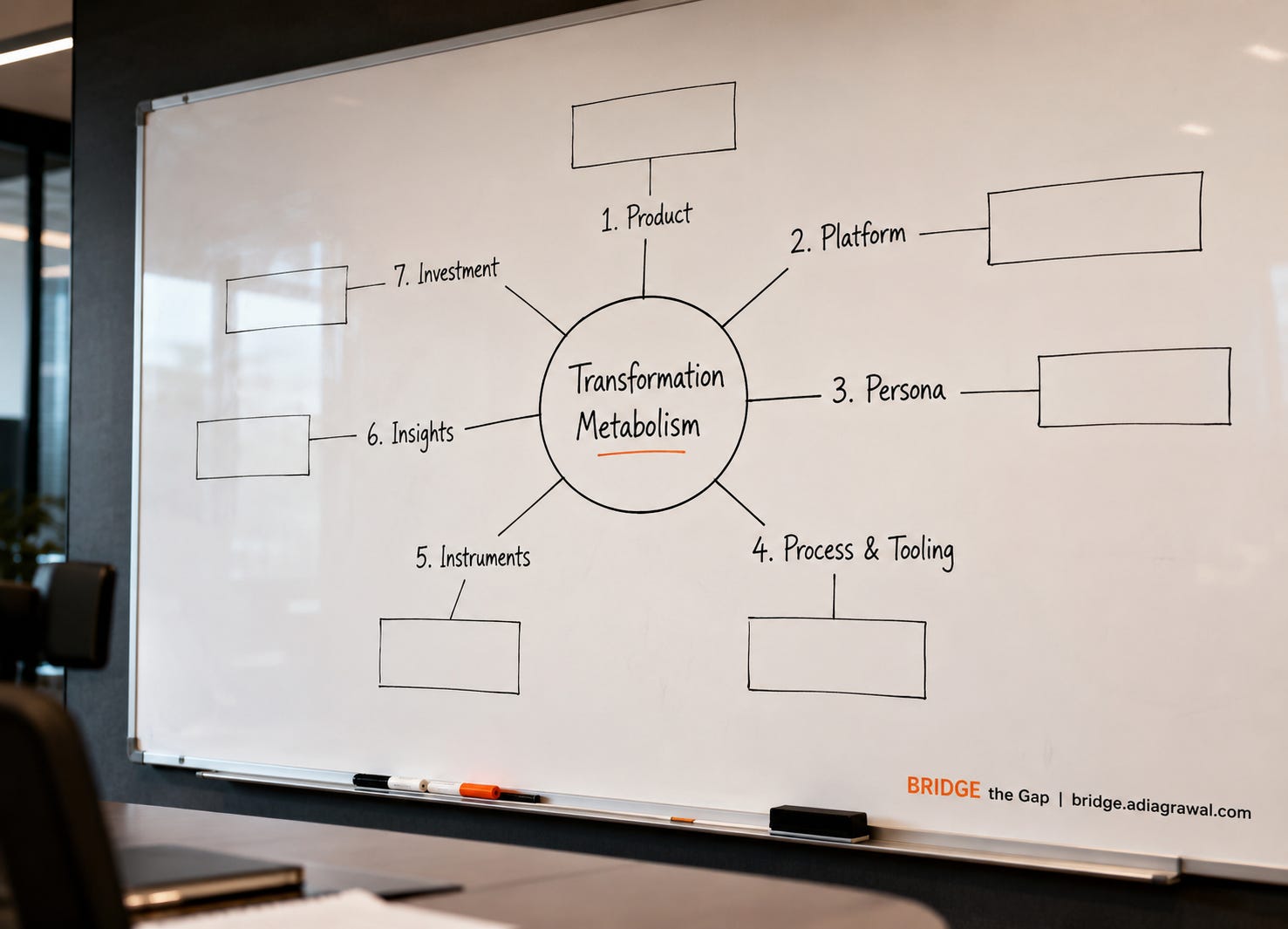
When James, the Meridian CEO, arrived and asked what it was, I called it a diagnostic.
P4I3©, Priya, translated from the far end. Four Ps and three Is. Transformation Metabolism at the center. How fast our organization converts inputs and learning into competitive capability. Not how fast we ship. How fast we learn and deploy value, and recover from being wrong.
That’s when we all started to build the strategy.
•••
Aligned
Marcus, the commercial group leader, started. “The plat…” — he stopped mid-word. “Wait. I’m going to say this, but I don’t actually know which spokes this maps into.”
No one in the room said anything.
“It’s called the Platform Rationalization Project,” he said. “Two million dollars. Nine months in. The goal was supposed to be faster iteration on product features, right? Lower cost of ownership. Better margins.” He trailed off, looking hopefully at his colleagues.
“Does it do that?” I asked.
“That’s the thing,” Marcus said. “It doesn’t map to Product. We’re not delivering or measuring customer value. It doesn’t map to Persona—it’s not about who we’re building for. It’s not a Process improvement because we’re not actually changing how anyone outside of the platform team works.” He sat back. “It maps to Platform, maybe. Or it should. But the Platform element isn’t connected to anything else on the wheel.”
That was a moment. A moment like many I have sat through when something clicks and brings a whole bunch of people together.
The Platform Rationalization Project was real. The money being spent was real. The team was competent. But the initiative existed in isolation. It was invisible infrastructure work without an articulation of the Product outcome it was supposed to enable. No Persona clarity. No Process redesign. No Insights infrastructure to measure whether it would actually reduce cost or iteration cycles. The Investment spoke was crowded—lots of capital going in—but none of the other spokes had moved.
“So what are we actually doing?” James asked.
“We are building a platform,” Priya said quietly, “and we never connected it to who we are supposed to serve.”
“That is a powerful insight,” I said as we started to align.
•••
Operating System
This is what people miss about transformation. You can execute beautifully on one element and produce nothing.
I’ve watched this pattern repeat. A company invests heavily in tools and technology, for example, data infrastructure and excellent Instruments. But no one builds the interpretive layer, the Insights function that converts data into decisions. So the platform ships out analysis, and dashboards track patterns that no one uses to do anything meaningful that adds customer value.
Or a team redesigns their entire operating model—Process and Tooling overhauled, completely professionalized. But nobody repositions the Product or revises the Persona focus, and they’re now moving fast in the wrong direction. Offering features that customers don’t need or want or dislike.
Meridian had done something worse. They had built the platform they thought they needed without asking the upstream questions: Who are we actually trying to serve? What product outcome is this supposed to enable? What decisions does this platform need to support? Will changing the platform actually change how fast we learn and deploy? Will this create customer delight and value? How will this create economic value?
The Platform Rationalization Project had already cost two million dollars of a three-million-dollar budget and an enormous amount of attention and relationship capital. But it wasn’t compounding or building leverage. It was just running.
I pointed at the wheel again. “Most transformations stall not because the strategy is wrong,” I said. You rationalized a platform strategy without building a transformation operating system around it. So the platform, even if it is best in class, will just sit there, isolated, demanding budget and attention while everything that was supposed to use it keeps working in a separate world. The old way.”
•••
Choice
This is when a leadership team has to choose.
You can continue the isolated initiatives. Fund the platform. Expect eventually it will find its audience, its purpose, its justification. You’ll wait, and the pressure will build, and eventually you’ll either abandon it or force teams onto it because you’ve already committed the money.
Neither will work.
Or you can stop. You can look at the seven spokes and ask, “What are we actually trying to transform? What does that require? What do we need to build together?”
You can take the Platform element and ask: What Product outcome does this enable? Whose Persona does it serve? What does our Process need to look like for teams to actually use it? What Instruments tell us it’s working? What Insights do we build on top of it? And what does this require from Investment?
You can turn the isolated initiative into a coherent system.
Your Transformation OS.
Or you can do nothing, and watch the two million become four, then five million, and watch the team rationalize why it’s still not working because the organization isn’t ready. That story has an ending, too. I’ve seen it in Stuttgart. I’ve seen it in many places.
What James Harrington chose that day—whether to treat the platform rationalization as a strategic input and build Meridian’s transformation operating system around it, or to treat it as a cost center and manage it as overhead—that choice determined the next three years of whether Meridian actually transformed.
•••
The wheel doesn’t lie about the gaps. But it only matters if you’re willing to make a choice.
Which elements of your strategy are running in isolation? And what would it cost to name that choice in front of the people who need to hear it?
Please do take a moment to share your thoughts, comments, likes, and questions.
And if you liked the story, please restack.
•••
Thank you for reading,
Adi
This lands for me because transformation trust often breaks less at the strategy layer and more at the continuation layer: who or what is still authorised to continue when context, evidence, risk, or customer impact changes. Curious whether you see that as part of the operating system problem too.